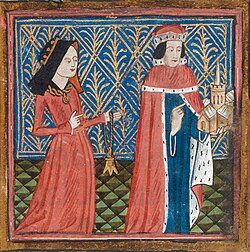
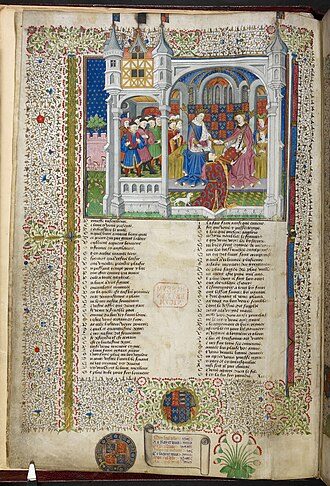
Picture 1 · 1431
Eleanor and Humphrey at St Albans
- About it The only picture of Eleanor made in her lifetime.
- Look for her red gown, the gold band in her hair, Humphrey's ermine-lined robe.
- Use for Scenes 1–2.
Creative writing · England, 1441 · Eight scenes
In 1441 Eleanor Cobham, Duchess of Gloucester and wife of the man next in line to the throne, was accused of using witchcraft against the king. You will tell her story in eight scenes: a historical short story of 1,200 to 1,600 words.
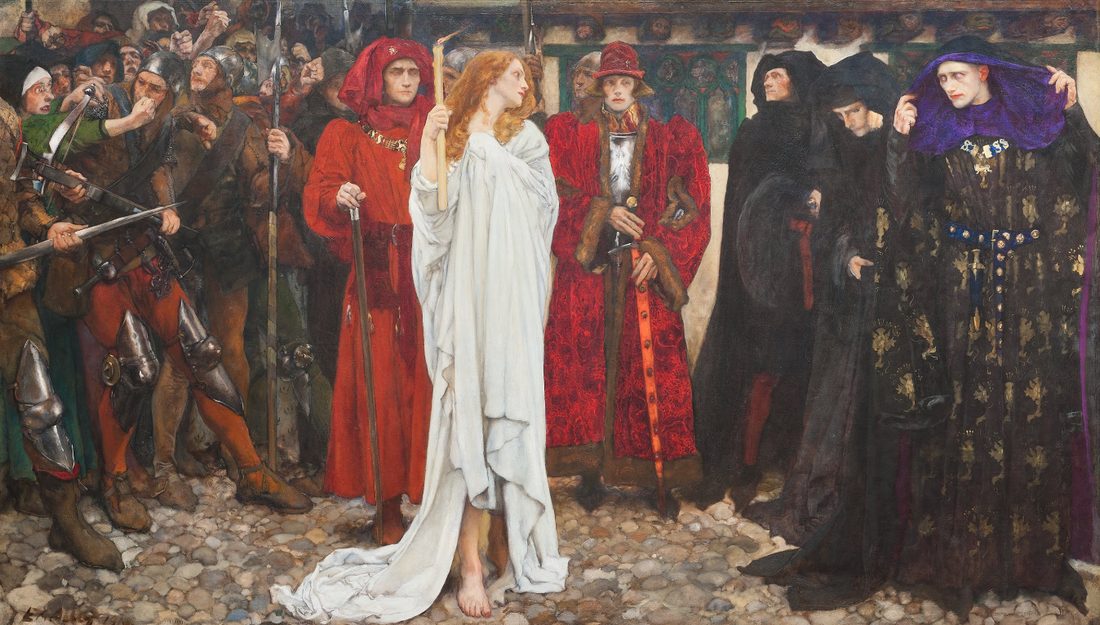
The history below gives you the skeleton: the real events, dates and people. You supply the flesh: what people said, felt, saw, heard and smelled.
You may invent dialogue, thoughts, servants, weather and small details. You may not change what actually happened.
Your goals: tell a story in the past tenses, write dialogue, use details from all five senses, and keep one point of view.
Eleanor Cobham was born around 1400, the daughter of a Kentish knight, Sir Reginald Cobham. She entered royal circles as a lady-in-waiting to Jacqueline of Hainault, wife of Humphrey, Duke of Gloucester. Humphrey's first marriage was declared invalid in 1428, and he married Eleanor sometime between 1428 and 1431.
Humphrey was the uncle of the boy-king Henry VI. When Humphrey's brother John, Duke of Bedford, died in 1435, Humphrey became heir presumptive: next in line to the throne. Eleanor was suddenly the wife of the man who might be king.
In 1441 two scholars in her circle, Roger Bolingbroke and Thomas Southwell, were accused of casting the king's horoscope to predict his death. Eleanor was accused of treason, sorcery and witchcraft. She was found guilty, forced to do public penance in the streets of London, divorced from her husband, and imprisoned for the rest of her life. She died a prisoner in 1452.
Was she a traitor, a fool, or a pawn in a political war between her husband and his rival, Cardinal Henry Beaufort? Historians still disagree. You decide.
| Name | Who they were |
|---|---|
| Eleanor Cobham | Knight's daughter who became Duchess of Gloucester; about 41 in 1441 |
| Humphrey, Duke of Gloucester | Eleanor's husband; uncle of the king; heir to the throne from 1435 |
| King Henry VI | The young king; 19 years old in 1441 |
| Cardinal Henry Beaufort | Humphrey's great political rival at court |
| Roger Bolingbroke | Oxford scholar, astrologer, and member of Eleanor's household |
| Thomas Southwell | Canon of St Stephen's, Westminster; astrologer |
| Margery Jourdemayne | Known as "the Witch of Eye"; sold potions and charms |
| John Hume | Eleanor's chaplain |
| Jacqueline of Hainault | Humphrey's first wife; Eleanor's former mistress |
Study each picture before you write the scene next to it. Four of these were painted within 11 years of Eleanor's trial; one was painted 459 years later and is imagined.
Picture 1 · 1431
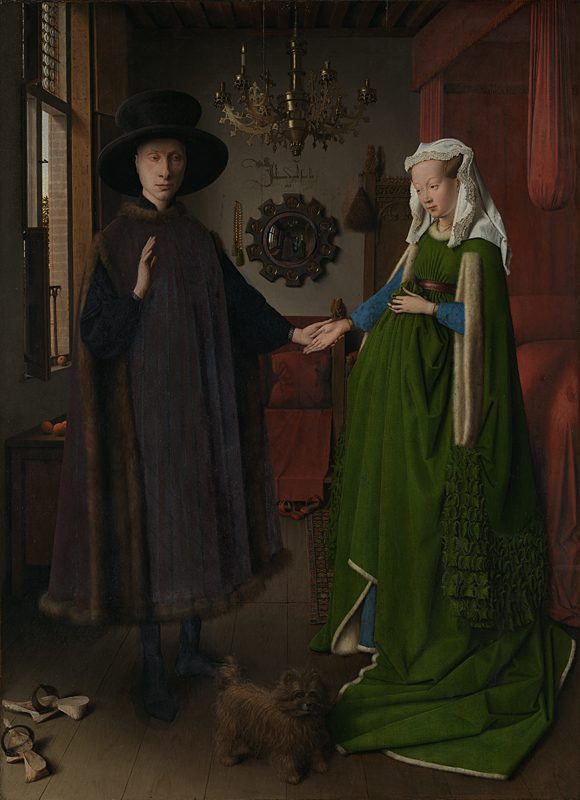
Picture 2 · 1434
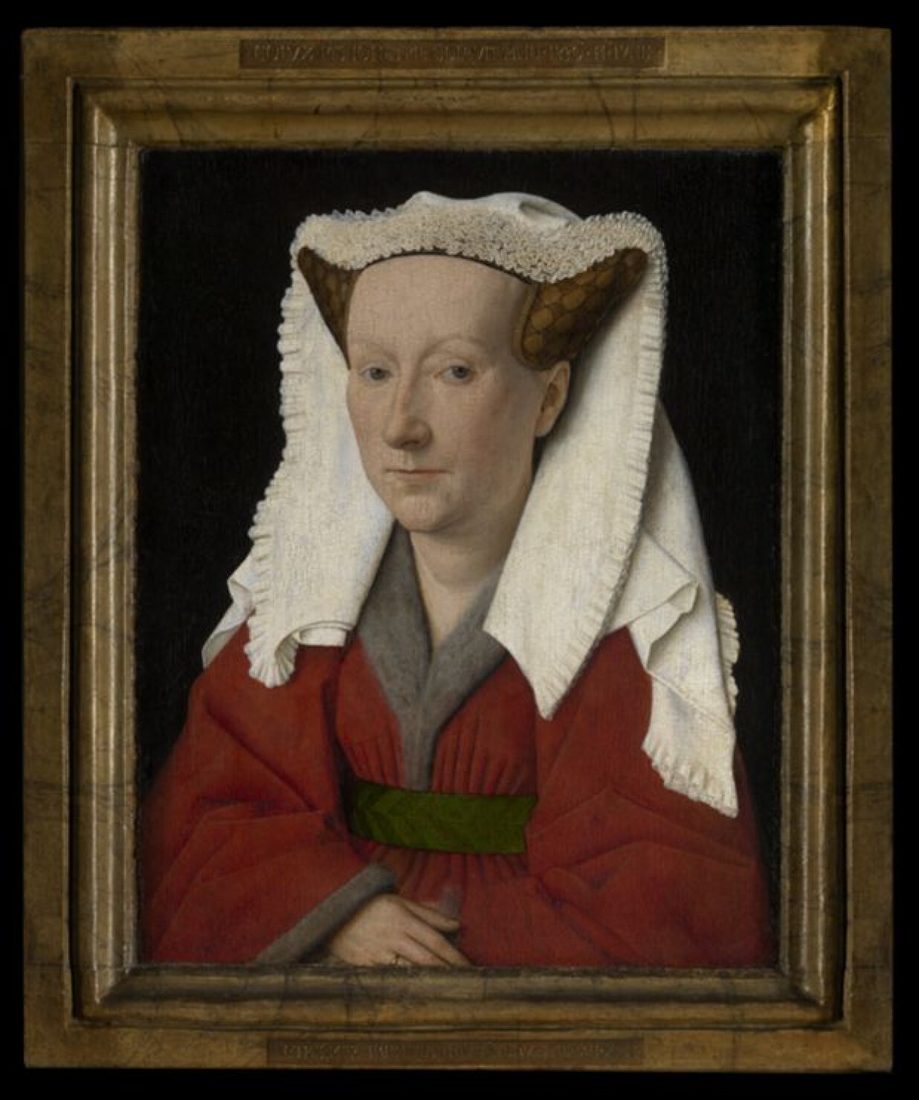
Picture 3 · 1439
Picture 4 · 1444–45
Picture 5 · 1900
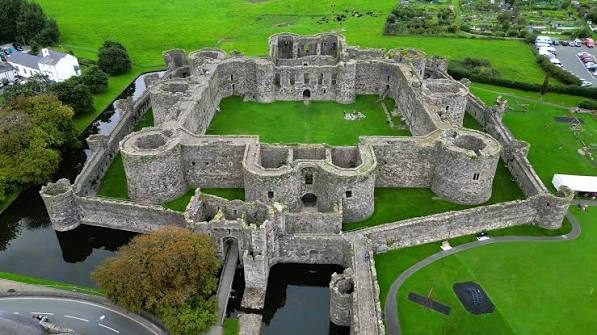
Picture 6 · Wales
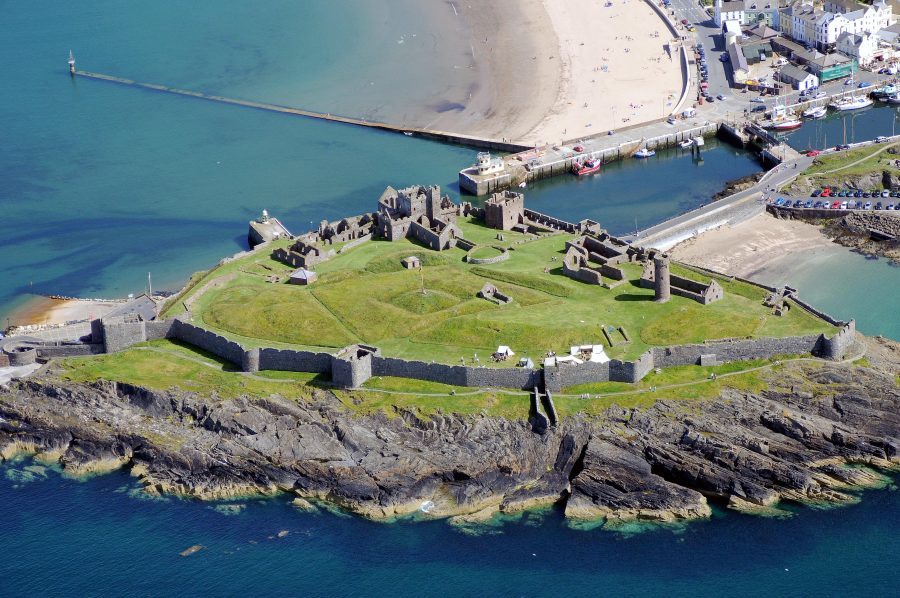
Picture 7 · Isle of Man
Choose one picture. Write five things you can see in it, then five things you could hear, smell or touch if you stepped inside it.
Use these real details to make your scenes feel true. Rich and poor lived in very different worlds, even on the same street.
| Sense | The streets of London | Eleanor's palace at Greenwich | Her prison castles |
|---|---|---|---|
| Sight | Open gutters and ditches down the middle of the street. People in wooden overshoes (pattens) to keep their feet out of the mud. | Fur-trimmed gowns, long trains, dagged (cut and scalloped) sleeves, hair pinned into "horns" under a veil. Brass chandeliers, silver, pewter and imported glass. | Thick stone walls, narrow windows, the grey sea. Beaumaris has a moat filled by the tide. |
| Sound | Cooks and tavern-keepers shouting what they sell. Church bells. Chanting and singing in religious processions. Bells tolling for funerals. | Musicians, poets and scholars: Humphrey and Eleanor's court was famous for them. | Wind, waves, gulls, a guard's keys, a door closing. |
| Smell | Very bad. Chamber pots, animal guts and blood were thrown into the gutters. Tanners used urine and dog dung to treat leather. The Thames carried sewage. People rarely washed and often owned one set of clothes. | Spices, roasting meat, hot spiced wine. Beeswax candles, which burn clean and do not stink. | Damp stone, smoke, cheap tallow candles made from animal fat, which are smoky and smell bad. |
| Taste | Pottage (thick soup or stew), coarse bread, ale. | Four courses: roast venison, goose, pigeon, beef; baked pears with spices and raisins; wafers and fritters; hypocras (sweet spiced wine). Oranges were a luxury. | Plainer food. No meat on Wednesdays, Fridays or Saturdays: these were church fast days for everyone. |
| Touch | Cold mud, rough wool, crowds pressing close. | Soft fur, silk velvet, fine linen napkins. People ate with their fingers and a small knife; there were no forks. | Cold stone floors, rough blankets, the heat of a small fire. |
Rule: every scene you write must use at least two senses from this guide besides sight. The words you use light up in each scene's word list.
Pick one point of view and keep it for the whole story.
Write each scene in the box below it. Your work saves on this computer as you type.
Eleanor served Jacqueline of Hainault, Humphrey's wife. Humphrey's marriage to Jacqueline was declared invalid by the Pope in 1428. Humphrey did not fight to keep Jacqueline. Instead, he married Eleanor.
Language focus: past simple and past continuous. She was carrying the duchess's gloves when he walked in.
Humphrey and Eleanor kept a lively court at their palace in Greenwich. Scholars, poets and musicians came there. In 1435, the Duke of Bedford died, and Humphrey became heir presumptive. Eleanor received rich gifts from the king.
Language focus: show, don't tell. Use actions and objects to show feelings.
Bolingbroke and Southwell cast a horoscope for King Henry VI. Their prediction: the king would fall seriously ill. Eleanor later admitted she had bought potions from Margery Jourdemayne; she said they were to help her have a child. Her accusers said the group also used a wax image of the king.
Language focus: reported speech. Bolingbroke said that the stars showed a sickness.
Bolingbroke was arrested. He was placed on a high platform at St Paul's Cross in London with his "magic" instruments and wax figures for the crowds to see. Eleanor fled to sanctuary at Westminster. She claimed to be sick and tried to escape secretly by boat on the river, but she was stopped and taken to a castle in Kent.
Language focus: short sentences for suspense; time words (suddenly, then, at that moment, before she could).
Eleanor was examined by a church court. On 23 October 1441, she faced Bolingbroke, Southwell and Margery, who said she was the cause of everything. She was accused of 28 charges and admitted 5. She denied treason. On 6 November 1441, her marriage to Humphrey was annulled.
Language focus: dialogue punctuation. "You lie," she said. "I asked only for a child."
Eleanor was sentenced to public penance on three days. On the first day, she walked bareheaded through London from Temple Bar to St Paul's Cathedral, carrying a lit wax taper, and offered it at the high altar. On the following days she walked to Christ Church and to St Michael's, Cornhill. The crowds were ordered not to harm her. A chronicle of the time says many people felt pity for her.
Language focus: vivid verbs (stumbled, flinched, stared, whispered instead of walked, looked, said).
Picture: 5 · The penance walk
Margery Jourdemayne was burned at Smithfield on 27 October 1441. Thomas Southwell died in the Tower of London on 28 October, the day before his trial; people said he died "of sorrow". Roger Bolingbroke was hanged, drawn and quartered at Tyburn on 18 November 1441. John Hume, Eleanor's chaplain, was pardoned.
Eleanor was moved from prison to prison: Chester Castle (1442), Kenilworth Castle (1443), Peel Castle on the Isle of Man (1446), and finally Beaumaris Castle on Anglesey in Wales (1449). Humphrey died in February 1447, while she was in prison. Eleanor died at Beaumaris on 7 July 1452, about 52 years old.
Before you send your final story, check each point.
Answer each question in three to five sentences.
Extension (optional). In Shakespeare's Henry VI, Part 2, Act 2, Scene 4, Humphrey watches Eleanor's penance. Read the scene and compare it with your Scene 6. What did Shakespeare add that the chronicles do not say?