Classic English Five Men, Five Fortunes

Descriptive writing · Five paintings · 1800s to today

Five men, five fortunes

Five paintings, painted across almost two hundred years, and every one of them is about men. Some drink together, some walk in the sun, some sit alone with a radio, a book or a prayer. You will describe each man, list what he owns, bring his things into 2026, and then decide who is really the richest.

Painting 1: the tavern Painting 2: two gentlemen in Milan Painting 3: the listener Painting 4: Gavin in his study Painting 5: the evening breviary

Ten ways to look at a painting

A good description has an order. First say what is there. Then say how it is painted. Only then say how it feels. If you begin with the feeling, you will have no evidence for it.

DimensionAsk yourself
What is there
ContentWho and what is in the picture?
GestureWhat are the bodies and hands doing?
CluesWhat do the objects tell you about this man and his life?
How it is painted
CompositionHow are the people and things arranged? Where does your eye go first?
LineAre the lines straight or curved? Are the edges hard or soft?
ColourWarm or cool? Bright or muted? What is the main colour family?
LightWhere does the light come from? Is it harsh or soft?
SpaceHow deep is the picture? What is near and what is far?
BrushworkIs the paint smooth or rough? Detailed or loose?
How it feels
MoodWhat feeling does the painting give you, and which details above create it?

Each painting below gives you four of these dimensions to write about. Together the five paintings use all of them.

Word bank

Use at least five of these adjectives in each description. As you type in the boxes below, the words you use will light up.

Light how it shines

radiant adj.
giving out bright, warm light. a radiant evening sky
mellow adj.
soft, warm and gentle. the mellow light of late afternoon
harsh adj.
very strong and hard on the eyes. harsh midday sun
dim adj.
not bright; hard to see clearly. a dim back room
shadowy adj.
full of shadows; hard to see into. a shadowy corner

Colour what shade

earthy adj.
brown, green and yellow, like soil and wood. earthy browns
sombre adj.
dark and serious. a sombre room
vivid adj.
very bright and strong. vivid red book spines
muted adj.
soft and not bright; quiet in colour. muted greens
ochre adj.
dark yellow-brown, like clay. an ochre counter

Line & brushwork how it is painted

rigid adj.
straight and stiff; it does not bend. rigid shelves
flowing adj.
moving smoothly, like water. the flowing folds of a coat
loose adj.
painted quickly and freely, not exactly. loose brushstrokes
meticulous adj.
very careful, showing every small detail. a meticulous painting of a clock
blurred adj.
not clear, with soft edges. a blurred crowd

Space near and far

cramped adj.
too small, with little room to move. a cramped corner
cluttered adj.
full of objects; untidy. a cluttered shelf
spacious adj.
large, with plenty of room. a spacious square
vast adj.
very, very large. a vast valley
distant adj.
far away. distant hills

Body & gesture how he holds himself

hunched adj.
with the back bent forward and the shoulders round. hunched over his glass
slouched adj.
sitting or standing in a lazy, relaxed way. slouched in an armchair
upright adj.
standing or sitting straight. an upright young man
idle adj.
not working; doing nothing. idle men in the afternoon
weary adj.
very tired. weary eyes

Character & mood how it feels

absorbed adj.
giving all your attention to one thing. absorbed in his book
nonchalant adj.
relaxed and not worried about anything. a nonchalant walk
contented adj.
happy and satisfied with what you have. a contented old man
devout adj.
deeply religious. a devout reader
wistful adj.
a little sad, thinking about the past or about something you cannot have. a wistful look

Wealth & health for the final task

affluent adj.
rich; having plenty of money. an affluent student
modest adj.
not large or expensive. a modest room
impoverished adj.
very poor. an impoverished worker
robust adj.
strong and healthy. two robust young men
frail adj.
weak and thin, often because of age or illness. a frail old man

Five paintings

The paintings move from a crowded room to one man alone on a hill. Look at each painting for one full minute before you read the notes. Then write a description of six to ten sentences that covers all four dimensions.

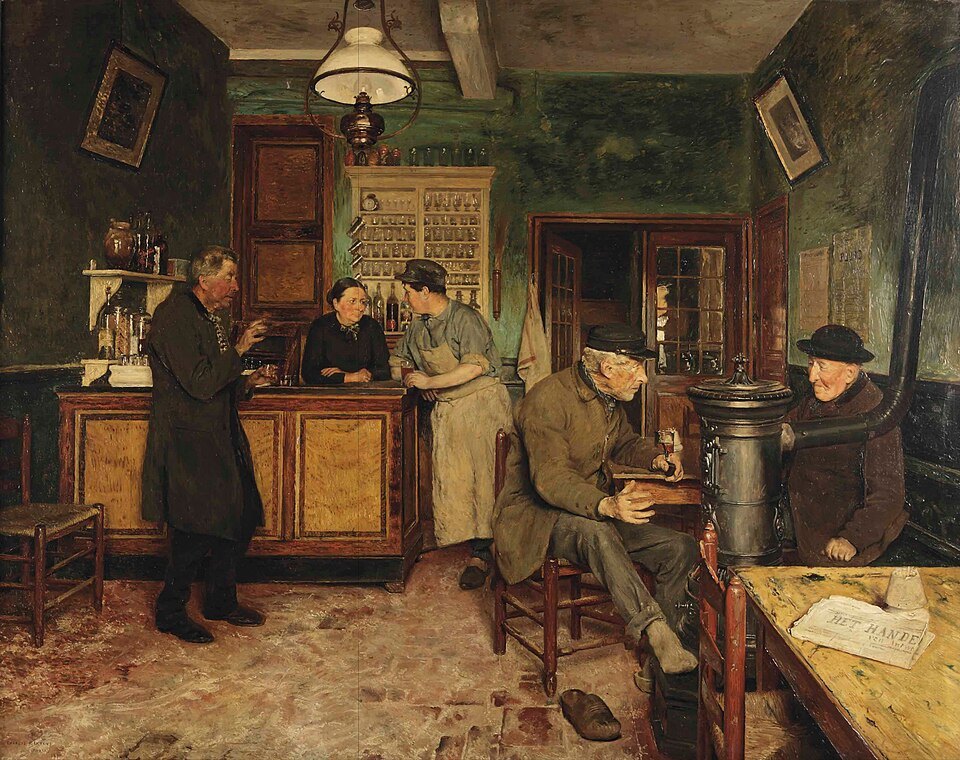
A tavern with green walls: a man in a long coat talks at the bar to a woman and a young man in an apron; on the right two old men sit by an iron stove; a newspaper lies on a yellow table.
Charles Mertens · Cabaret · oil on canvas

Painting 1 · five people

The tavern

Charles Mertens, Belgian. In Belgium, a cabaret was a small local bar.

  • CompositionThe room splits into two groups. Who stands at the bar, and who sits by the stove? Look at the empty floor between them. Does anyone cross it?
  • LineFind the straight lines: door frames, shelves, the bar counter, the stovepipe. Are there many curves? How does all that straightness feel?
  • GestureWatch the hands. The man in the long coat raises one hand as he talks. The old man by the stove holds a small glass. What is each man doing?
  • CluesA wooden clog lies on the floor. The newspaper's name begins HET HANDE…, which is Dutch. What do these things tell you about these men and where they live?
  • rigid
  • sombre
  • earthy
  • hunched
  • weary
  • idle
  • dim
0 word-bank adjectives0 words
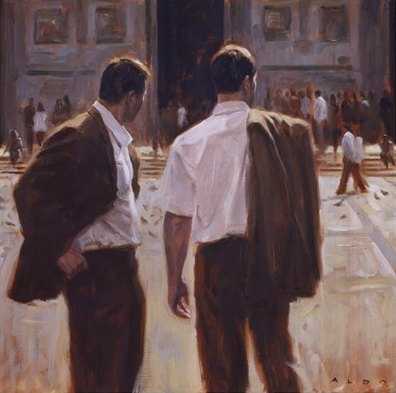
Two men seen from behind walk across a bright square in white shirts and dark trousers; one has his hand in his pocket, the other carries his jacket over his shoulder; a blurred crowd and a large building are ahead.
Aldo Balding · Two Gentlemen in Milan · oil

Painting 2 · two people

Two gentlemen in Milan

Aldo Balding, British, born 1960. The only living painter in this lesson.

  • BrushworkLook closely. Can you see separate brush marks? Which parts are sharp and which are blurred? Look at the crowd in the background.
  • LightThe sun is strong. Look at the white shirts and the bright ground. Where are the shadows?
  • GestureOne man has a hand in his pocket. The other carries his jacket over his shoulder. What do these gestures say about their day?
  • MoodWe only see their backs. They are walking away from us. How does that make you feel as the viewer?
  • loose
  • blurred
  • harsh
  • radiant
  • nonchalant
  • upright
  • spacious
0 word-bank adjectives0 words
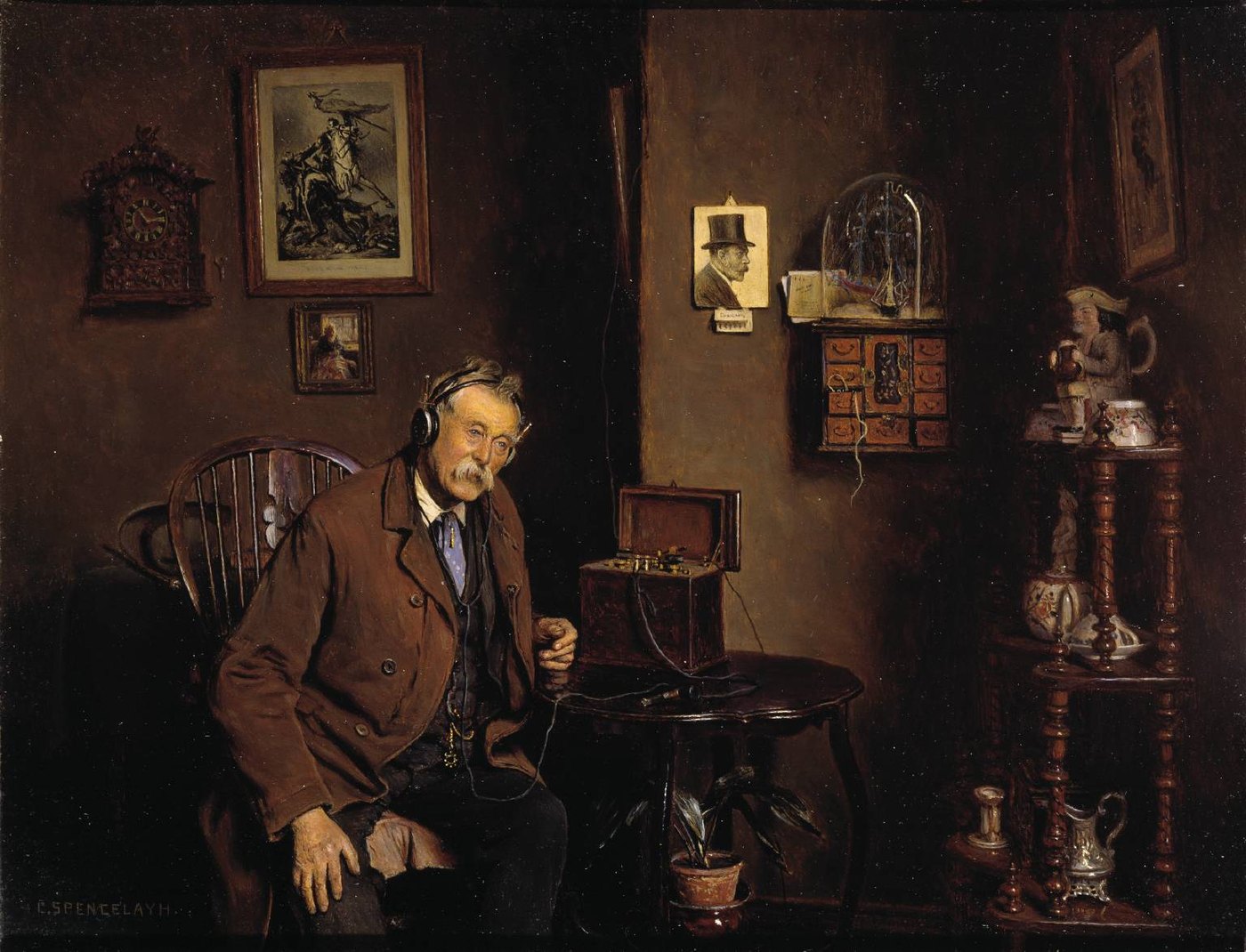
An old man with a white moustache sits in a wooden chair wearing headphones, wired to a radio set in an open wooden box; around him are a cuckoo clock, framed prints, a ship under a glass dome and a shelf of china.
Charles Spencelayh · The Listener · oil

Painting 3 · one person

The listener

Charles Spencelayh, English. He painted scenes of English home life for about seventy years.

  • GestureHe wears headphones and leans toward the radio. Look at his hand, his eyes and the angle of his head. What is he trying to do?
  • LightThe light comes from the left. Which parts of him does it touch? What happens to the rest of the room?
  • CluesFind the cuckoo clock, the ship under a glass dome, the Toby jug (a jug shaped like a man) and the portrait of a man in a top hat. What kind of life has he lived?
  • BrushworkLook at the wood of the chair and the cloth of his coat. Is the paint rough or smooth? Could this be a photograph?
  • meticulous
  • absorbed
  • shadowy
  • cluttered
  • frail
  • sombre
  • cramped
0 word-bank adjectives0 words
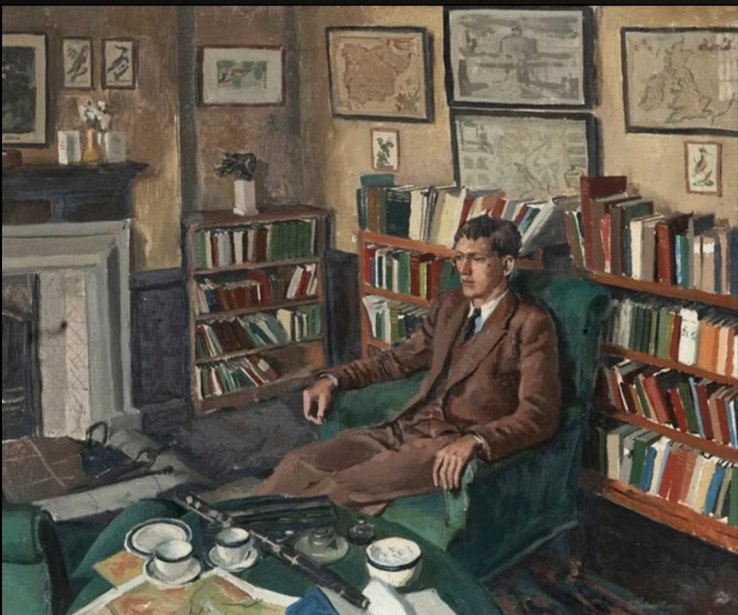
A young man in a brown suit sits back in a green armchair in a room lined with bookcases and framed maps; a fireplace is on the left and a table with teacups and a flute is in the front.
Stephen Bone · Gavin in his study at St John's · oil on canvas

Painting 4 · one person

Gavin in his study

Stephen Bone, English, painting his older brother Gavin, a student at St John's College, Oxford.

  • ColourName the three main colour families. Where does the green appear? What do the book spines add?
  • SpaceThe room goes back to the wall of maps, but the table at the front seems to tilt up toward us. Does the room feel deep or flat?
  • CluesFind the maps, the books, the flute on the table, the bird prints and the tea things. What does this young man study, and what does he enjoy?
  • MoodHe sits back and looks out of the picture, away from us. What might he be thinking about?
  • vivid
  • earthy
  • cluttered
  • slouched
  • contented
  • wistful
  • affluent
0 word-bank adjectives0 words
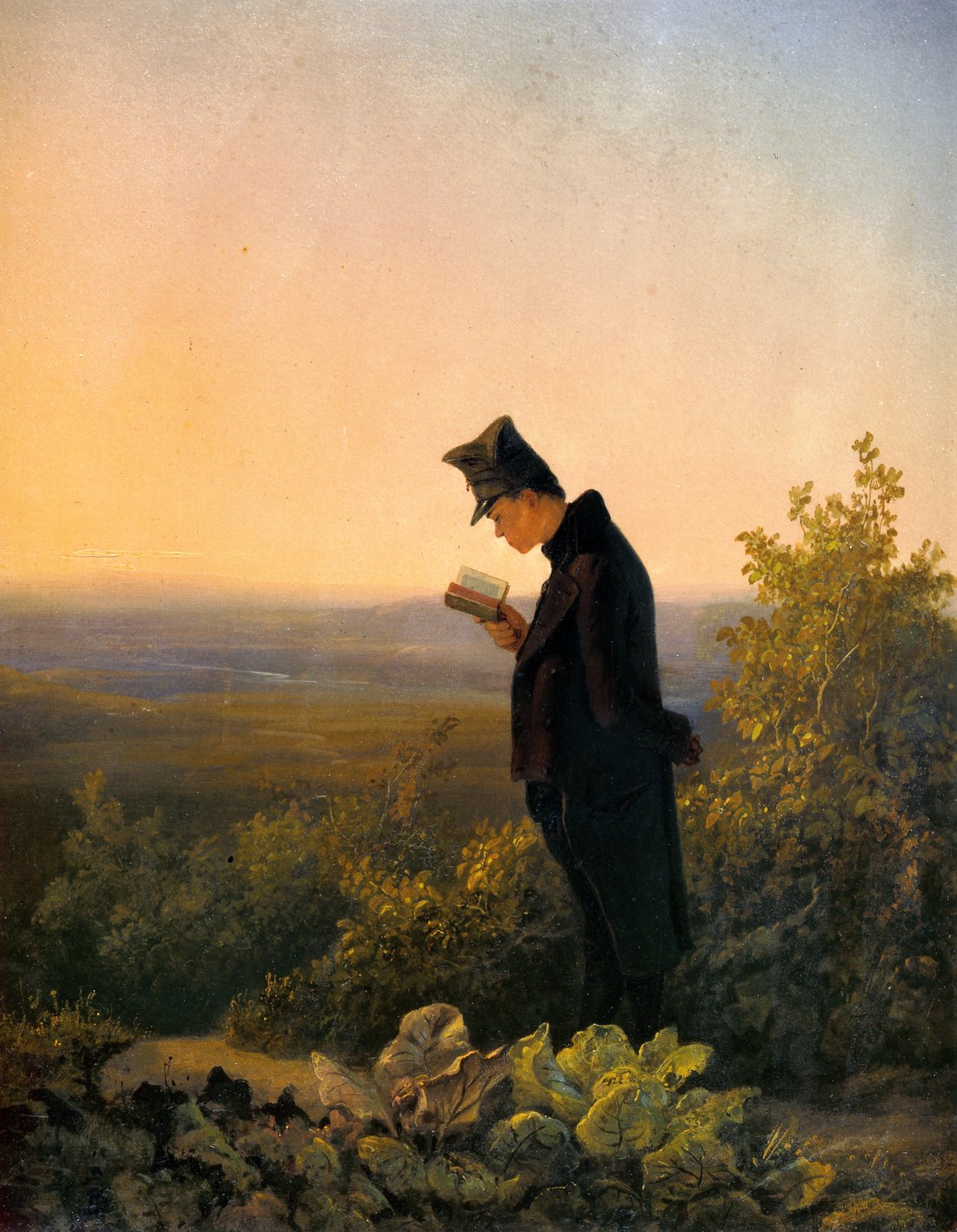
A man in a dark coat and cap stands on a hilltop at sunset reading a small book, one hand behind his back; bushes glow gold around him, cabbages grow at his feet, and blue hills stretch to the horizon.
Carl Spitzweg · Das Abendbrevier (The Evening Breviary) · oil

Painting 5 · one person, outdoors

The evening breviary

Carl Spitzweg, German. A breviary is the book of daily prayers that Catholic priests read, so this man is probably a priest.

  • SpaceLook past the man to the hills. How many layers of land can you count before the sky? What happens to their colour as they go further away?
  • LightThe sun is low. Which side is it on? Look at the edges of the leaves and the left side of the sky.
  • ColourDescribe the sky from left to right and from top to bottom. Compare it with the dark shape of the man.
  • MoodHe reads alone, on a hill, at the end of the day, one hand behind his back. What is he feeling?
  • radiant
  • mellow
  • vast
  • distant
  • devout
  • absorbed
  • upright
0 word-bank adjectives0 words

What they own, then and now

Things change faster than people. Choose one object from each painting and write what a man would use for the same job in 2026.

Example: a candle → an LED lamp

Price check (optional)

Choose one of your 2026 items. Find its price on a real shop website and paste the website address.

Who is richer?

There is more than one way to be rich. Rank the five men from 1 (the richest) to 5 (the poorest) in each of the three kinds of wealth below. Use each number once. Then explain your ranking with evidence from the paintings.

Useful language. You are guessing from pictures, so show it: he probably…, he seems to…, he might…, judging by his…, this suggests that…

Compare: The listener is poorer than Gavin, but he is less lonely than he looks. The two gentlemen are the most robust men in the set.

The painters

The five painters come from three countries and span almost two hundred years. Knowing when and where each artist worked helps you understand what each man owns.

Carl Spitzweg

Munich, 1808 – Munich, 1885 · Germany

Spitzweg trained as a pharmacist and passed his exams in 1832. A year later, with money from a family inheritance, he gave up pharmacy to paint. He taught himself by copying old Flemish paintings. He is the best-known painter of the Biedermeier period, when German artists painted quiet middle-class life. His humour is gentle, never cruel. His most famous painting is The Poor Poet (1839).

Charles Mertens

Antwerp, 1865 – Calverley, England, 1919 · Belgium

Mertens first trained as a goldsmith in his father's workshop, then studied at the Royal Academy of Fine Arts in Antwerp, where he became a professor in 1886. His early paintings are small, exact scenes of ordinary life, like this one. Later he painted fishermen and the river Scheldt in brighter light. During the First World War he lived near Leeds, the same city as Grimshaw, and he died there in 1919.

Charles Spencelayh

Rochester, 1865 – 1958 · England

Spencelayh grew up admiring Charles Dickens, and like Dickens he loved small details of character and home. He was a founder member of the Royal Society of Miniature Painters in 1897. Queen Mary bought his paintings. He painted until three weeks before he died. His old men sit among clocks, china and souvenirs, and every object is painted with great care.

Stephen Bone

Chiswick, London, 1904 – London, 1958 · England

Stephen was the son of the artist Sir Muirhead Bone. He won a gold medal for wood engraving in Paris in 1925 and was an official war artist in the Second World War. His brother Gavin (1903–1942) entered St John's College, Oxford in 1925 and later taught there. Gavin's students included the poet Philip Larkin and the novelist Kingsley Amis. He translated Old English poetry, played the flute and loved wild orchids. He died in 1942, aged 34.

The painting's title says "early 1920s", but Gavin only arrived at St John's in 1925. Which date do you trust?

Aldo Balding

Born 1960 · Britain, lives in the south of France

Balding began as an illustrator before he moved to France to paint full time. He usually works with only five or six colours and paints fast, wet paint into wet paint. His scenes are like moments from a film: couples in cafés, men lost in thought. He never tells you the story; you have to imagine it.

Final task

Answer this question in one paragraph of eight to twelve sentences: Which of the five men is the richest overall, when you count money, spirit and body together? Use your rankings, at least four adjectives from the word bank, and one fact from "The painters."

0 word-bank adjectives0 words