Classic English Grimshaw

Descriptive writing · Victorian painting

The eternally moonlit world of John Atkinson Grimshaw

Grimshaw (1836–1893) painted the same hour again and again: a cold moon, bare trees, a wet road, and one warm window. In this lesson you will look closely at four of his moonlit lanes and describe them in your own words.

How to describe a painting

Good description moves the reader's eye through the picture in a clear order. Do not list everything. Choose the details that create the feeling of the scene.

  1. Start with the sky. Where is the moon? What colour is the sky? Are there clouds?
  2. Move to the middle. Describe the trees, houses, walls and windows. Which parts are light, and which are dark?
  3. End on the ground. Describe the road and the people on it. What is the surface like? Where are the people going?
  4. Name the mood. Finish with one sentence about the feeling of the painting, and say which details create it.

Word bank

Use at least five of these adjectives in each description. As you type in the boxes below, the words you use will light up.

Light how it shines

luminous adj.
giving off a soft, clear light. the luminous moon
gleaming adj.
shining brightly, usually because the surface is smooth or wet. gleaming cobblestones
glistening adj.
shining with small points of light because it is wet. a glistening road after rain
silvery adj.
bright grey-white, like silver. silvery puddles
golden adj.
warm yellow, like gold or lamplight. a golden glow at the end of the lane
dim adj.
not bright; hard to see clearly. a dim corner under the trees

Colour what shade

pallid adj.
very pale, with almost no colour; often a little unhealthy-looking. a pallid sky
wan adj.
weak and pale. the wan light of a winter moon
amber adj.
orange-yellow, like honey or a lit window. amber windows
violet adj.
blue-purple. a violet evening sky
murky adj.
dark and dirty-looking, so you cannot see through it. murky green clouds
muted adj.
soft and not bright; quiet in colour. muted browns and greens

Shape & texture what it looks like

skeletal adj.
thin and bony, like a skeleton. Good for bare winter trees. skeletal branches
gnarled adj.
twisted and rough with age. a gnarled old trunk
tangled adj.
twisted together in a confused mass. tangled twigs against the sky
weathered adj.
changed and worn by rain, wind and time. a weathered stone wall
looming adj.
appearing large, dark and a little threatening. a looming house
slick adj.
smooth, wet and slippery. the slick road

Mood how it feels

hushed adj.
very quiet, as if everyone is holding their breath. a hushed street
solitary adj.
alone; the only one. a solitary walker
desolate adj.
empty and lonely, with no comfort. a desolate road
melancholy adj.
sad in a quiet, thoughtful way. a melancholy autumn evening
eerie adj.
strange and a little frightening. an eerie green light
serene adj.
calm and peaceful. a serene night

Four moonlit lanes

Look at each painting for one full minute before you read the notes. Then write a description of five to eight sentences in the box.

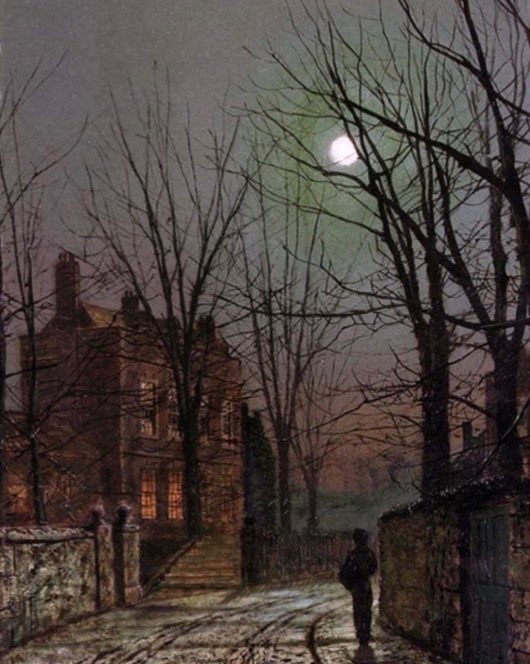
A moonlit lane beside a brick house with glowing windows; a figure in a dark coat walks along a stone wall under bare trees.
John Atkinson Grimshaw · oil on canvas

Painting 1

A walker by the old house

  • SkyA full moon shines through bare branches. The sky is a soft grey-violet, and the moon makes a small white halo.
  • MiddleOn the left stands a tall brick house. Its windows glow orange, and stone steps lead up to it. Thin trees rise against the sky.
  • GroundA pale road with cart tracks runs between two stone walls. One person in a dark coat walks towards us, alone.

Notice the two kinds of light: the cold moon above and the warm windows below. Grimshaw puts these side by side in almost every picture. The warm light suggests home and safety; the cold light suggests loneliness.

  • luminous
  • skeletal
  • amber
  • looming
  • weathered
  • solitary
  • wan
0 word-bank adjectives0 words
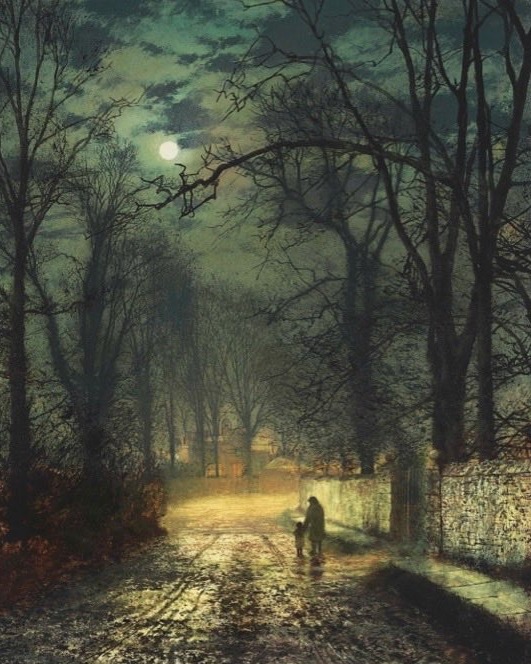
A lane under tall dark trees and a green cloudy sky; the road glows gold and a woman leads a small child along it.
John Atkinson Grimshaw · oil on canvas

Painting 2

A mother and child in the golden lane

  • SkyBroken clouds race across a green sky. The moon is small and sharp, high on the left.
  • MiddleTall trees on both sides make a dark tunnel. At the far end, lights from houses glow yellow.
  • GroundThe road shines gold, as if lit from inside. A woman holds a small child's hand and walks away from us. Ivy covers the wall on the right.

This is the brightest painting of the four. The light seems to come from the road itself. Grimshaw often made wet surfaces brighter than the sky, which pulls your eye down to the people.

  • golden
  • murky
  • glistening
  • tangled
  • serene
  • dim
  • eerie
0 word-bank adjectives0 words
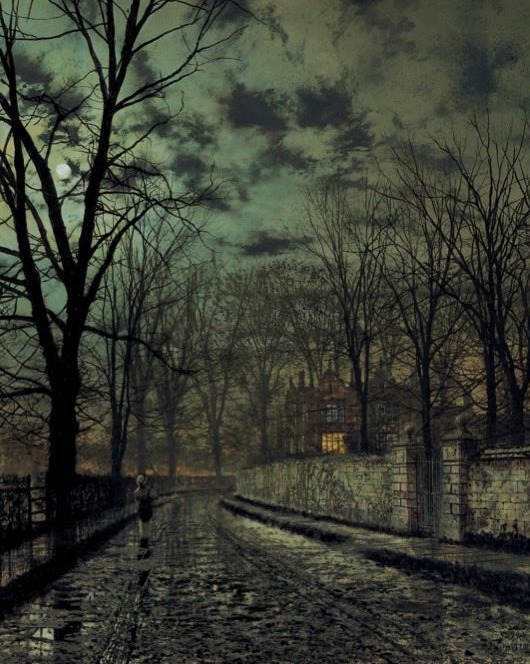
A long straight wet road under a cloudy green sky, with a stone wall and gate on the right and a lit window in a house behind the trees.
John Atkinson Grimshaw · oil on canvas

Painting 3

The long wet road

  • SkyHeavy clouds fill most of the picture. The moon is almost hidden, a small white spot on the far left.
  • MiddleA row of bare trees runs into the distance. Behind a high stone wall, one window in a large house glows yellow.
  • GroundThe road is soaked with rain and reflects the sky like a mirror. A tiny figure walks on the left, almost lost in the dark.

The road and the wall both lead your eye deep into the picture. This is called perspective. The person is very small, which makes the night feel large and empty.

  • slick
  • silvery
  • desolate
  • muted
  • skeletal
  • hushed
  • weathered
0 word-bank adjectives0 words
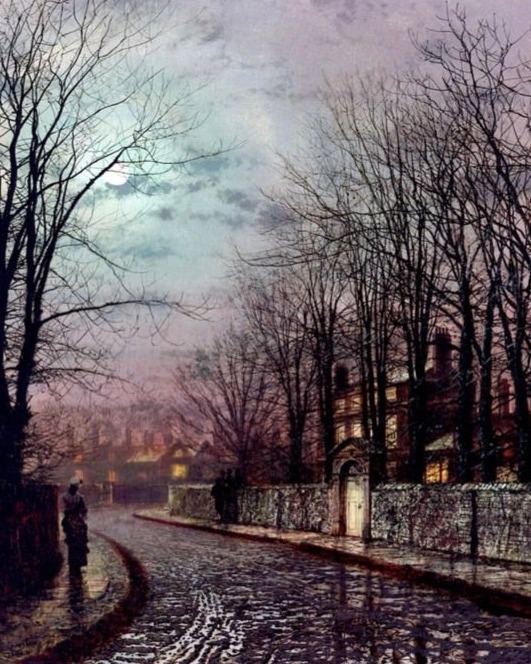
A curving cobbled street under a pink and pale blue sky; a woman in a long dress stands on the left and an arched doorway is set in a stone wall.
John Atkinson Grimshaw · oil on canvas

Painting 4

The violet evening street

  • SkyThe sky is pink near the rooftops and pale blue above. The moon sits low on the left behind a thin cloud.
  • MiddleBrick houses with lit windows line the right side. An arched white doorway is set into the garden wall. Two figures stand far off near the wall.
  • GroundThe cobbled street curves away from us. Every stone shines. A woman in a long Victorian dress stands at the left edge.

Here the colours are cooler and softer than in the other three paintings. The curve of the road gives the picture movement, and the woman at the edge seems to be waiting for someone.

  • violet
  • gleaming
  • pallid
  • melancholy
  • gnarled
  • solitary
  • amber
0 word-bank adjectives0 words

Grimshaw in his time

John Atkinson Grimshaw lived during the reign of Queen Victoria (1837–1901). His home city, Leeds, was a busy industrial centre in the north of England, full of factories, railways and smoke. His paintings show the quiet edges of that world: suburban lanes, old halls and harbours at night.

Style

Grimshaw was a realist. He painted bricks, branches and wet stones in sharp detail, so his pictures look almost like photographs. He was interested in photography and is believed to have used a camera obscura, a device that projects a scene onto a surface so an artist can trace it.

His colours are nearly monochrome: each painting is built from one main family of colour, such as green, blue, violet or amber.

Movement

As a young man he followed the ideas of the critic John Ruskin, who told artists to show "truth to nature." This links him to the Pre-Raphaelites, a group of Victorian painters known for bright colour and exact detail.

Later he gave less attention to tiny details and more to the effect of moonlight and shadow. In this way he is close to the nocturnes (night paintings) of the American painter James McNeill Whistler, who became his friend.

“I considered myself the inventor of nocturnes until I saw Grimmy's moonlit pictures.”
James McNeill Whistler, on Grimshaw

His life

  1. Born on 6 September in Leeds. His parents were strict and did not want him to become an artist.
  2. Married Frances (Fanny) Hubbard. Four of their children later became painters.
  3. Left his job as a clerk with the Great Northern Railway, at age 24, to paint full time. He had no formal art training.
  4. Moved his family into Knostrop Old Hall, a large old house outside Leeds. He also kept a house in Scarborough on the coast.
  5. Began showing work at the Royal Academy in London, though he mostly sold to private buyers.
  6. Died on 31 October at Knostrop Old Hall, aged 57.

Today his moonlit scenes are his best-known and most valuable works.

Final task

Choose your favourite painting. Write one paragraph that answers this question: What feeling does Grimshaw create, and how does he use light to create it? Use at least three adjectives from the word bank and one fact from "Grimshaw in his time."

0 word-bank adjectives0 words