Classic English A Space Gene?
Classic English · History · Lesson map

A Space Gene?

Between 1959 and 1967 NASA chose 66 men to fly into space. Five hundred years earlier, a different group of men sailed off the edge of the known map. Put both groups on one map of Europe and look at where their families came from.

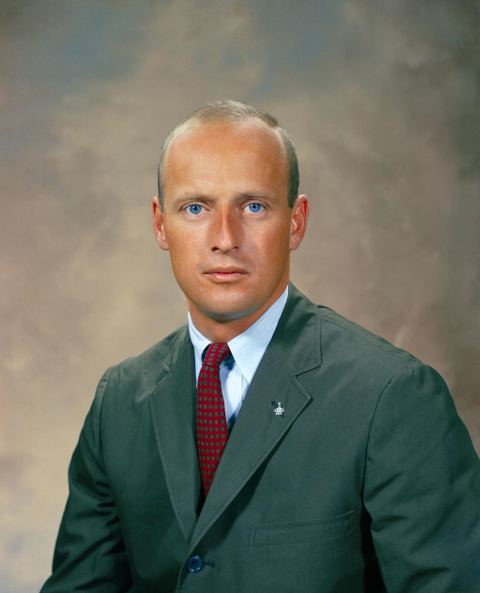
Studio portrait of a 1960s NASA astronaut in a jacket and tie, wearing an astronaut pin
NASA portrait, 1960s

The explorers17 MEN · BY BIRTHPLACE

    The astronauts66 MEN · BY FAMILY ORIGIN

      What the map shows

      The explorers' centre of gravity sits in south-western France, pulled there by Genoa, Lisbon and Seville. The astronauts' centre of gravity sits in the North Sea, pulled there by families from Britain, Germany and the Low Countries. Between them is a shift of about kilometres north. It makes sense that the center of gravity shifts northward for space exploration because, after all, space is cold.

      How the astronauts were placed: each man is pinned to the country his surname comes from, unless a source shows his documented family line. Three entries are sourced (Carpenter, Schirra, Cernan, shown in blue on the name list); the other 63 are surname assumptions. A centre of gravity is the average position of all the pins in a group, with each astronaut country weighted by how many men it holds.

      History · 1957–1969

      The Race

      The Soviet Union put the first satellite into orbit in October 1957. A year later the United States founded NASA, and in April 1959 it named its first seven astronauts. For the next six years the Soviets reached almost every milestone first, and the Americans answered, sometimes within weeks. In 1965 the lead changed hands, and by 1969 only one country had put men on the Moon.

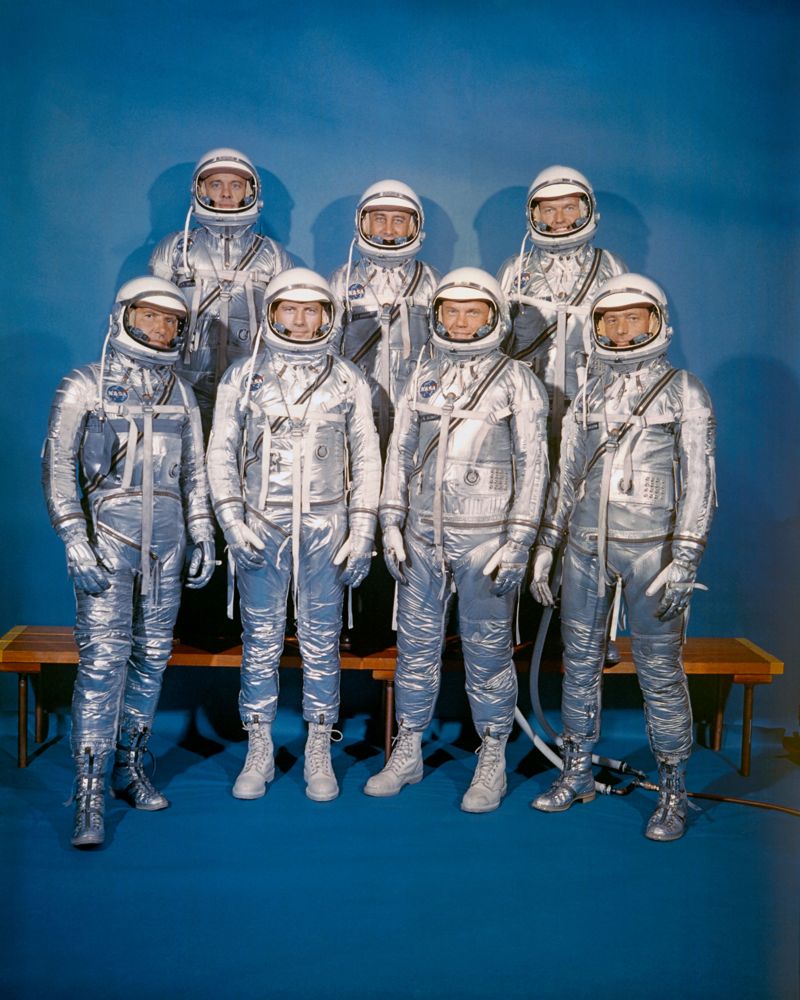
      The seven Mercury astronauts in silver pressure suits and helmets, posed in two rows against a blue backdrop
      The Mercury Seven, NASA, 1959
      MilestoneSoviet firstAmerican answerGap
      Human in spaceGagarin, Vostok 1, Apr 12, 1961Shepard, Freedom 7, May 5, 196123 days
      Human in orbitGagarin, Apr 12, 1961Glenn, Friendship 7, Feb 20, 1962314 days
      Sleep in spaceTitov, Vostok 2, Aug 1961Cooper, Faith 7, May 1963647 days
      Woman in spaceTereshkova, Vostok 6, June 16, 1963Sally Ride, 198320 years
      Crew of more than oneVoskhod 1, Oct 12, 1964Gemini 3, Mar 23, 1965162 days
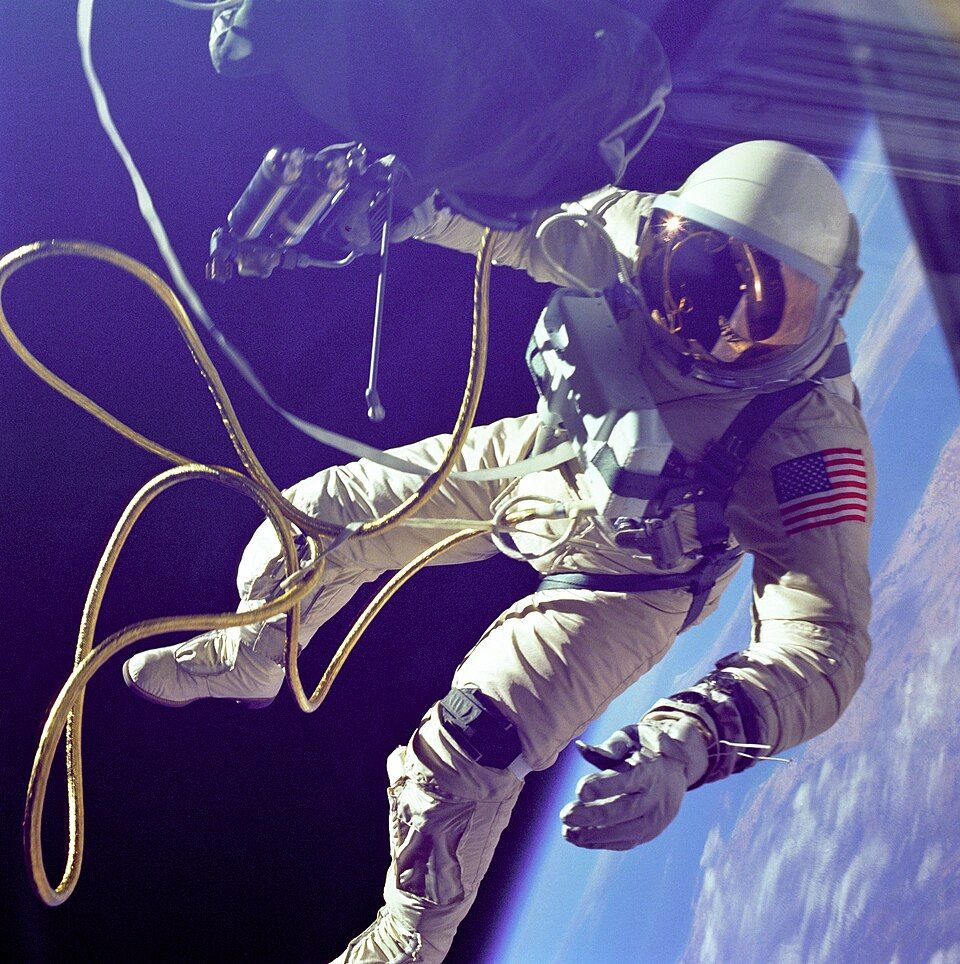
      SpacewalkLeonov, Voskhod 2, Mar 18, 1965White, Gemini 4, June 3, 196577 days
      Soft landing on the Moon (no crew)Luna 9, Feb 3, 1966Surveyor 1, June 2, 1966119 days
      Docking two craft in orbitSoyuz 4 and 5, Jan 1969Gemini 8, Mar 16, 1966 (first)US ahead by 2 yr 10 mo
      Humans around the MoonZond 5 carried tortoises, Sept 1968Apollo 8, Dec 1968 (first humans)3 months
      Humans on the MoonNeverApollo 11, July 20, 1969—

      Mercury1961–1963 · ONE MAN

      • Apr 12, 1961Vostok 1. Yuri Gagarin orbits Earth once, the first human in space.Soviet first
      • May 5, 1961Freedom 7. Alan Shepard flies a 15-minute up-and-down hop, 23 days after Gagarin.
      • Feb 20, 1962Friendship 7. John Glenn circles Earth three times in 4 hours 55 minutes, the first American in orbit.
      • May 15–16, 1963Faith 7. Gordon Cooper stays up 34 hours 19 minutes and flies the capsule home by hand after its electrics fail.Longest Mercury flight
      • June 16, 1963Vostok 6. Valentina Tereshkova becomes the first woman in space.Soviet first
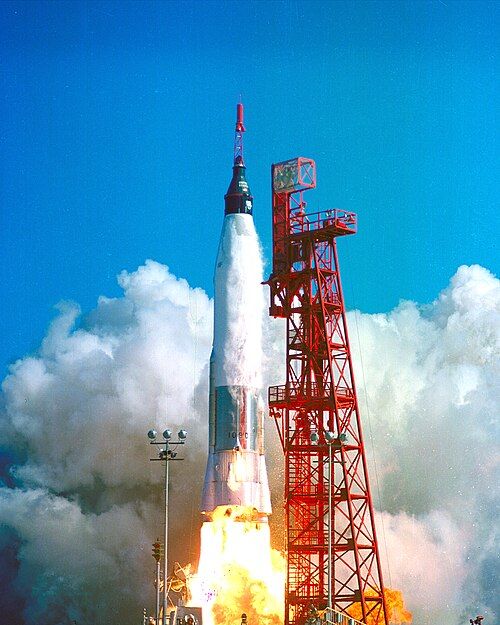
      An Atlas rocket lifting off beside a red launch tower, with white clouds of exhaust
      Friendship 7 launch, Cape Canaveral, February 20, 1962
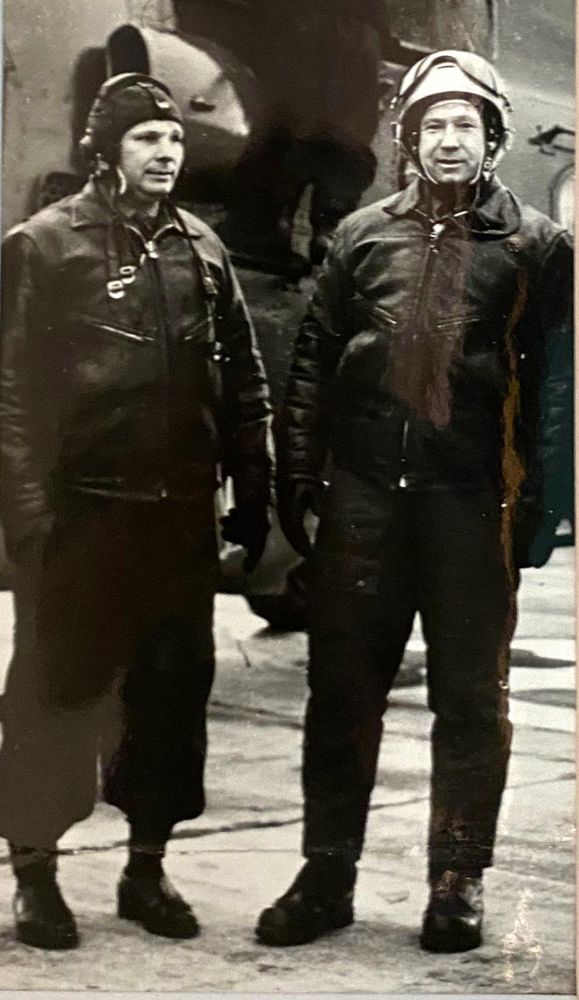
      Black-and-white photograph of Yuri Gagarin and Alexei Leonov in flight jackets in front of a helicopter
      Yuri Gagarin and Alexei Leonov, signed photograph

      Gemini1965–1966 · TWO MEN

      • Mar 18, 1965Voskhod 2. Alexei Leonov makes the first spacewalk.Soviet first
      • June 3, 1965Gemini 4. Ed White makes the first American spacewalk, 77 days after Leonov.
      • Aug 1965Gemini 5. Cooper and Pete Conrad stay up 190 hours 56 minutes, long enough for a trip to the Moon and back. The endurance record passes to the United States.Endurance record
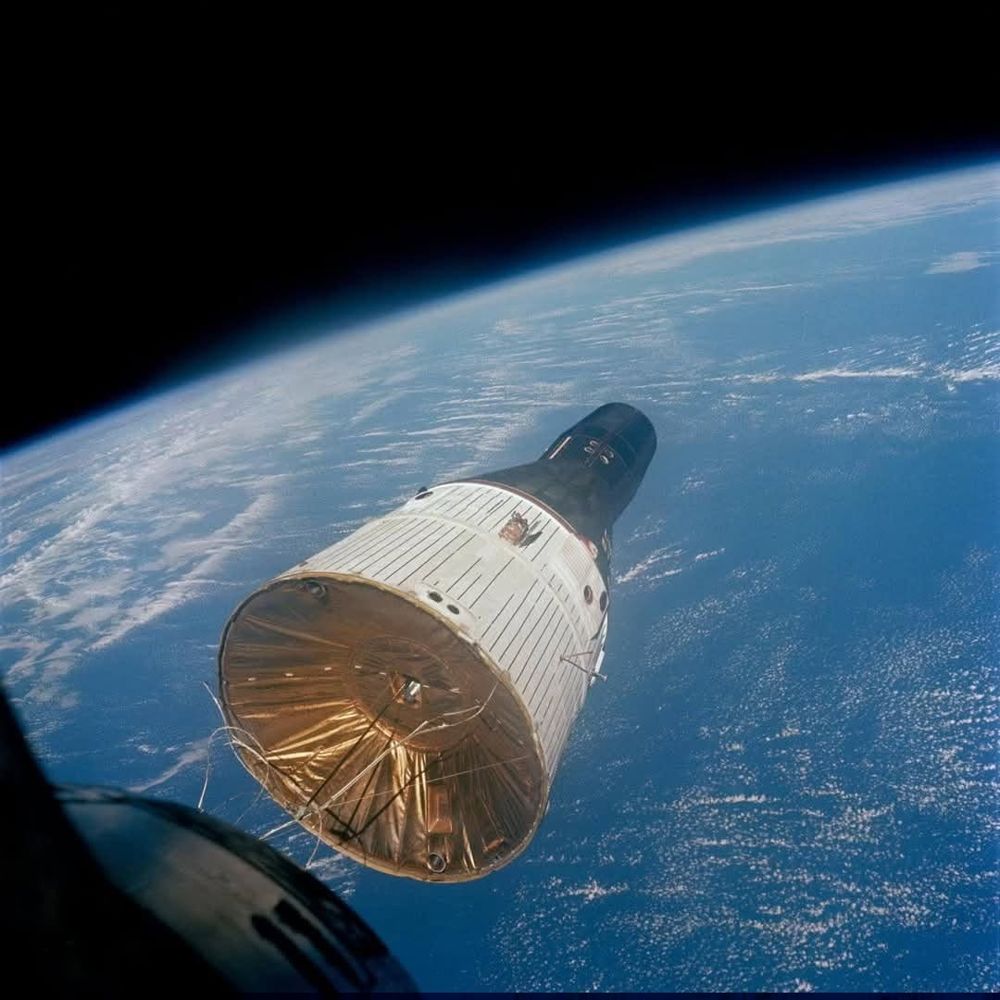
      • Dec 1965Gemini 7 and 6A. Frank Borman and Jim Lovell spend almost 14 days in orbit. Gemini 6A flies up to meet them, the first rendezvous of two crewed spacecraft.First rendezvous
      • Mar 16, 1966Gemini 8. Neil Armstrong and David Scott dock with a target vehicle, the first docking in orbit.First docking
      • Sept 1966Gemini 11. Conrad and Richard Gordon climb to about 1,370 km above Earth.Highest Earth orbit of the era

      From Gemini 5 on, the Americans lead.

      An astronaut floating in space on a gold tether above Earth, with a gold visor and an American flag on his shoulder
      Ed White's spacewalk, Gemini 4, June 3, 1965
      A Gemini spacecraft above the curve of the Earth, seen from another spacecraft
      Gemini 7 seen from Gemini 6A, December 1965

      Apollo1967–1969 · THREE MEN

      • Jan 27, 1967Apollo 1. A fire in the capsule during a launch-pad test kills Gus Grissom, Ed White and Roger Chaffee.
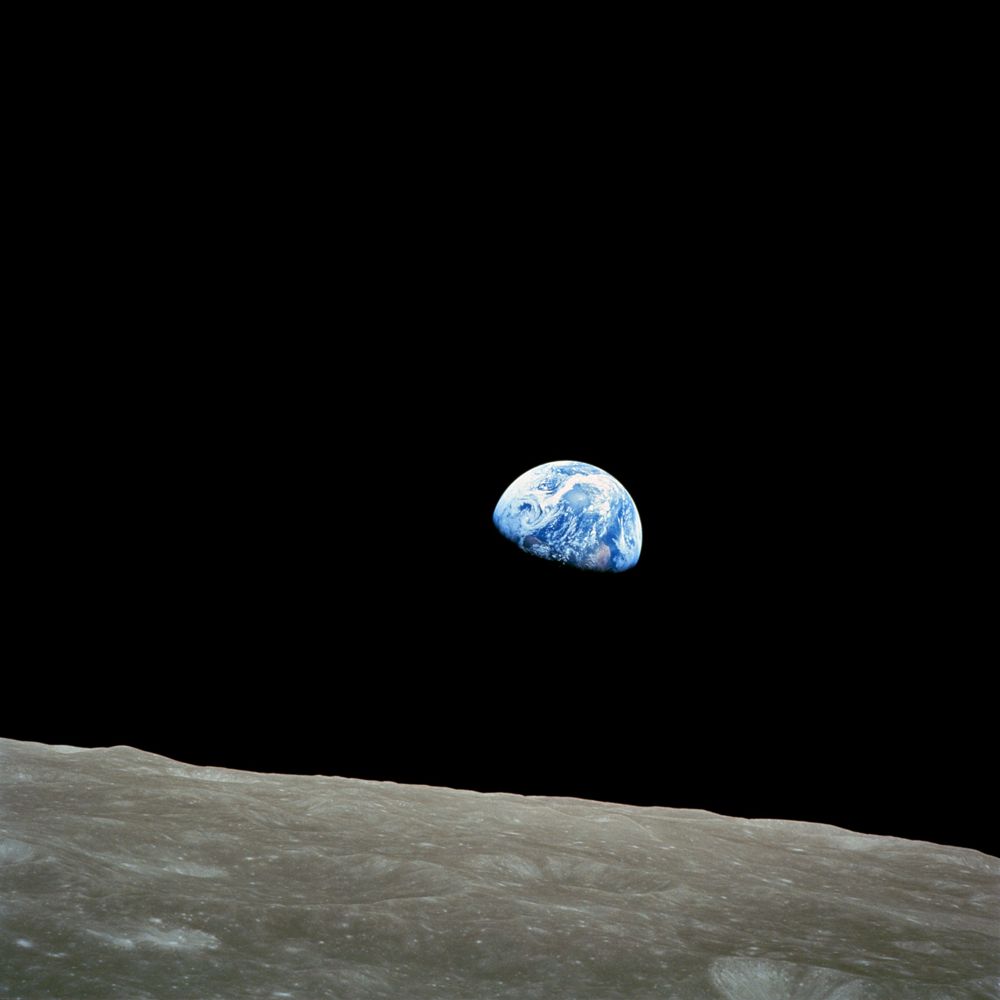
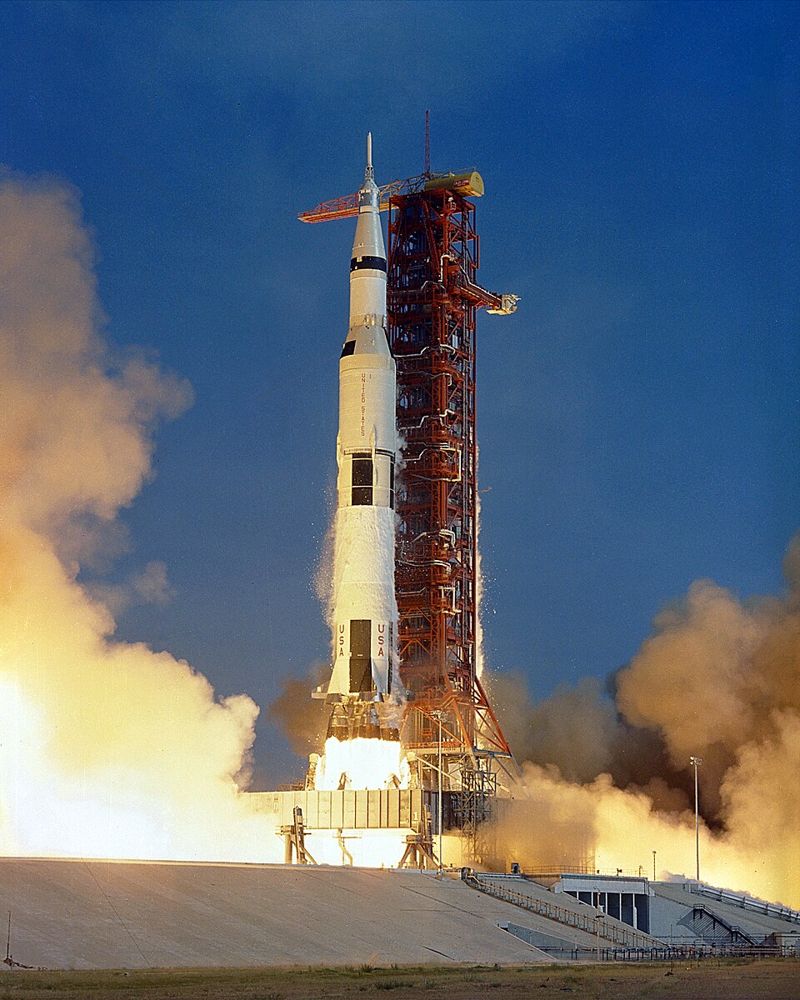
      • Dec 21–27, 1968Apollo 8. Borman, Lovell and William Anders ride the first crewed Saturn V, 110.6 metres tall, and become the first humans to leave Earth's orbit, circle the Moon and see its far side.First to the Moon
      • May 1969Apollo 10. The dress rehearsal flies to within 15 km of the lunar surface. Coming home, its crew reaches 39,937 km/h, the fastest any humans have travelled. The record still stands.Fastest humans ever
      • July 20–21, 1969Apollo 11. Armstrong and Buzz Aldrin land on the Moon while Michael Collins orbits above. Armstrong steps onto the surface at 02:56 UTC on July 21.First on the Moon
      The Earth, partly lit, rising above the grey horizon of the Moon against black space
      "Earthrise," Apollo 8, December 24, 1968
      A Saturn V rocket lifting off beside its red launch tower, with orange flame and smoke at its base
      Apollo 11 launch, July 16, 1969
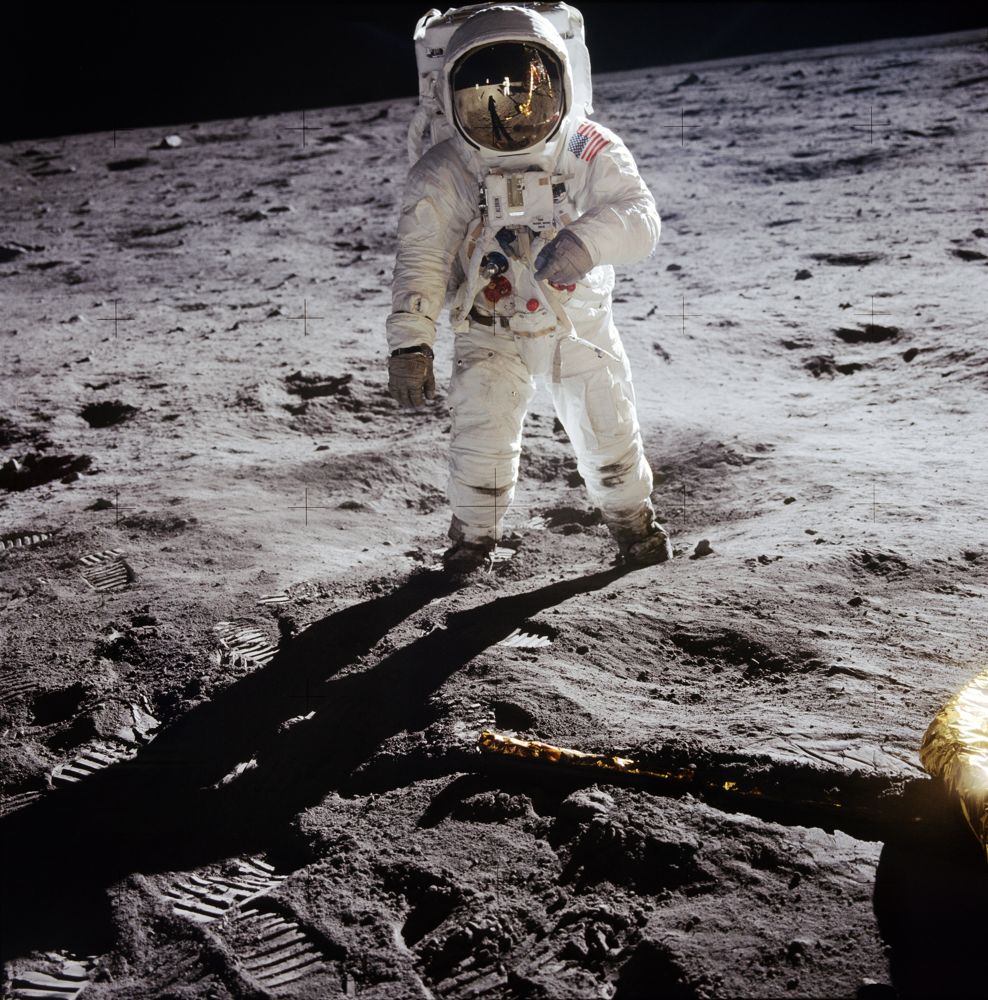
      An astronaut in a white spacesuit standing on the Moon, the lunar module reflected in his gold visor
      Buzz Aldrin on the Moon, Apollo 11, July 20, 1969
      Biographies · 12 of the 66

      The Men

      Almost every one of the 66 came through the same door: a military academy or an engineering degree, then years as a military pilot, then test-pilot school. Read the twelve cards below. Each one ends with the same three lines, so you can compare where the men came from, how they got in, and what they flew.

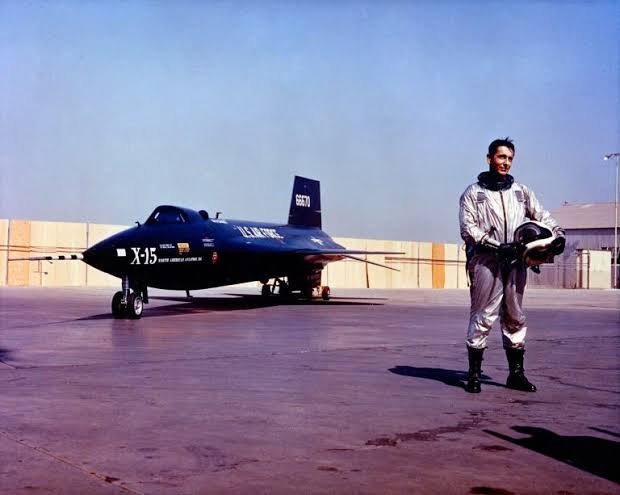
      A test pilot in a silver pressure suit holding his helmet, standing beside a black X-15 rocket plane on the ramp at Edwards Air Force Base
      Scott Crossfield, North American Aviation's chief engineering test pilot, with the X-15 at Edwards, June 8, 1959
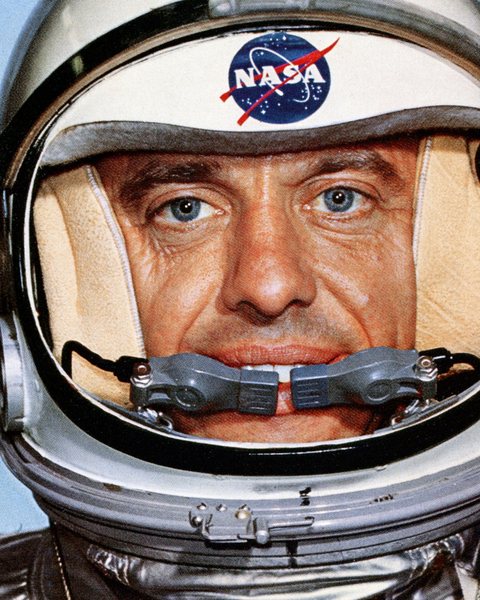
      Alan Shepard in a Mercury helmet and silver pressure suit

      Alan Shepard1923–1998

      Born in East Derry, New Hampshire, the son of an army officer. He graduated from the U.S. Naval Academy in 1944 and served on a destroyer in the Pacific, then became a navy pilot and a test pilot at Patuxent River. On May 5, 1961, he became the first American in space, 23 days after Gagarin. An inner-ear disorder grounded him for years. Surgery fixed it, and he walked on the Moon in 1971 at age 47.

      Map pin
      England
      Route in
      Naval Academy → navy pilot → test pilot
      Flights
      Freedom 7, Apollo 14
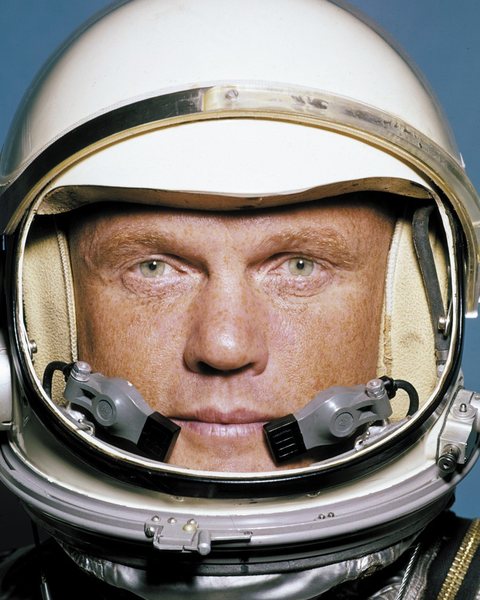
      John Glenn in a Mercury helmet

      John Glenn1921–2016

      Born in Cambridge, Ohio, the son of a plumber. He left Muskingum College to fly for the Marines in the Second World War, then shot down three MiGs in Korea. In 1957 he made the first supersonic flight across the United States. In 1962 he became the first American to orbit Earth. He later served 24 years as a U.S. senator and returned to space at 77.

      Map pin
      Scotland
      Route in
      College → Marine pilot → test pilot
      Flights
      Friendship 7, STS-95
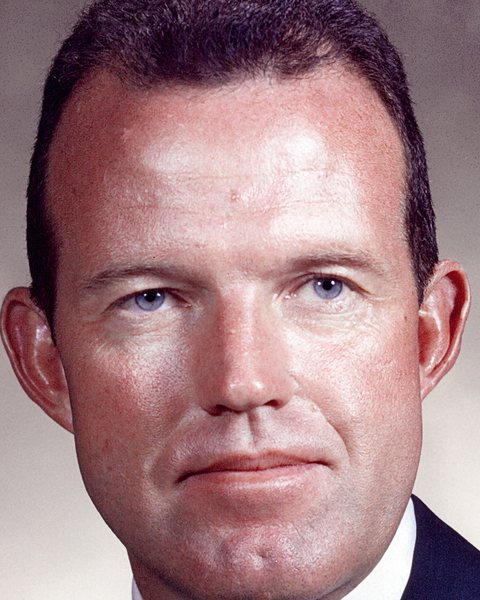
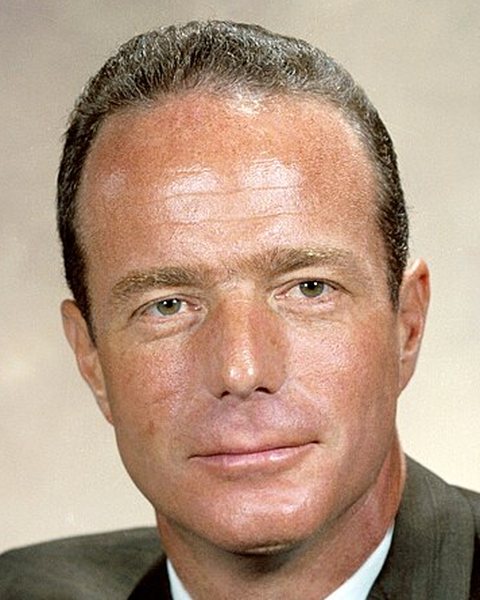
      Gordon Cooper in a jacket and tie

      Gordon Cooper1927–2004

      Born in Shawnee, Oklahoma. His father flew with the National Guard, and Cooper flew solo unofficially at 12. He served in the Marines, flew fighters for the Air Force in West Germany, and earned an aerospace engineering degree. He was the youngest of the seven. He flew the last Mercury mission home by hand after its electrics failed.

      Map pin
      England
      Route in
      Marines → Air Force pilot → engineering degree → Edwards test pilot
      Flights
      Faith 7, Gemini 5
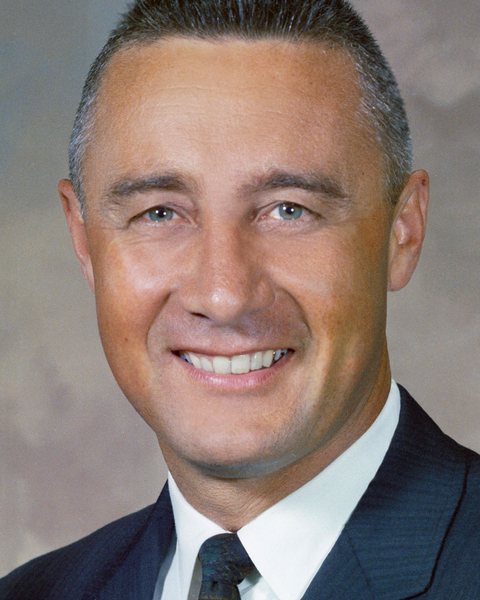
      Gus Grissom in a suit beside a model rocket and an American flag

      Gus Grissom1926–1967

      Born in Mitchell, Indiana. He worked his way through a mechanical engineering degree at Purdue and flew 100 combat missions in Korea. He was the second American in space, but his capsule, Liberty Bell 7, sank after splashdown and he nearly drowned. He commanded Gemini 3, the first American two-man flight. He died in the Apollo 1 fire.

      Map pin
      England
      Route in
      Purdue → Air Force pilot → test pilot
      Flights
      Liberty Bell 7, Gemini 3
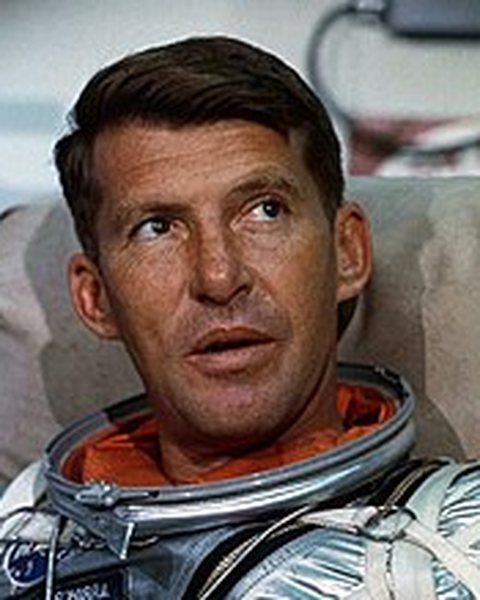
      Wally Schirra in a silver Mercury pressure suit

      Wally Schirra1923–2007

      Born in Hackensack, New Jersey. His father was a barnstorming pilot and his mother did wing-walking stunts. His grandfather came from Loco, in the Italian-speaking part of Switzerland. He graduated from the Naval Academy in 1945 and flew 90 combat missions in Korea. He is the only astronaut who flew Mercury, Gemini and Apollo.

      Map pin
      Switzerland
      Route in
      Naval Academy → navy pilot → test pilot
      Flights
      Sigma 7, Gemini 6A, Apollo 7
      Scott Carpenter in a suit, arms folded on a green cloth, beside an American flag

      Scott Carpenter1925–2013

      Born in Boulder, Colorado, and raised by his grandparents. His family tree runs through English, Swiss-German, Dutch and Ulster Scots lines. He studied aeronautical engineering at the University of Colorado and flew navy patrol planes in Korea. On Aurora 7 in 1962 he landed about 400 km off target. Later he lived on the sea floor as an aquanaut in the navy's SEALAB program.

      Map pin
      England
      Route in
      University → navy pilot → test pilot
      Flights
      Aurora 7
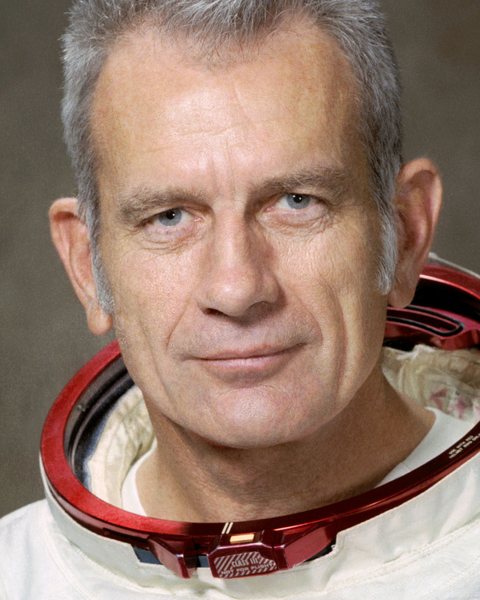
      Deke Slayton in a white spacesuit beside a model of the Apollo and Soyuz spacecraft

      Deke Slayton1924–1993

      Born on a farm near Sparta, Wisconsin. He flew bombers over Europe and the Pacific in the Second World War, then earned an aeronautical engineering degree at the University of Minnesota. An irregular heartbeat grounded him before his Mercury flight, so he ran the astronaut office and chose the crews. He finally flew in 1975, 16 years after he was selected.

      Map pin
      England
      Route in
      Bomber pilot → engineering degree → Edwards test pilot
      Flights
      Apollo–Soyuz
      NA

      Neil Armstrong1930–2012

      Born in Wapakoneta, Ohio. He had a pilot's licence before a driver's licence. He went to Purdue on a navy scholarship and flew 78 combat missions in Korea. As a civilian test pilot at Edwards he flew the X-15 rocket plane seven times. He saved Gemini 8 when a thruster stuck. On July 21, 1969, he became the first person to walk on the Moon.

      Map pin
      Scotland
      Route in
      Purdue → navy pilot → civilian test pilot
      Flights
      Gemini 8, Apollo 11
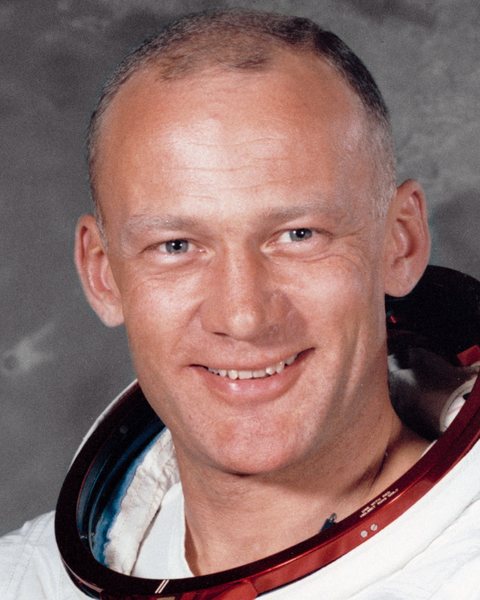
      Buzz Aldrin smiling in a white spacesuit in front of a photograph of the Moon

      Buzz Aldrinb. 1930

      Born in Glen Ridge, New Jersey. His mother's maiden name was Moon. He graduated third in his class at West Point and shot down two MiGs in Korea. He then earned a doctorate at MIT with a thesis on how spacecraft meet in orbit, which earned him the nickname "Dr. Rendezvous." On Gemini 12 he showed that spacewalks could be done without exhaustion.

      Map pin
      Scandinavia
      Route in
      West Point → Air Force pilot → MIT doctorate
      Flights
      Gemini 12, Apollo 11
      MC

      Michael Collins1930–2021

      Born in Rome, the son of a U.S. Army general, and raised on army bases around the world. He graduated from West Point and became an Air Force test pilot at Edwards. He flew Gemini 10, and on Apollo 11 he circled the Moon alone while Armstrong and Aldrin walked on it.

      Map pin
      Ireland
      Route in
      West Point → Air Force pilot → Edwards test pilot
      Flights
      Gemini 10, Apollo 11
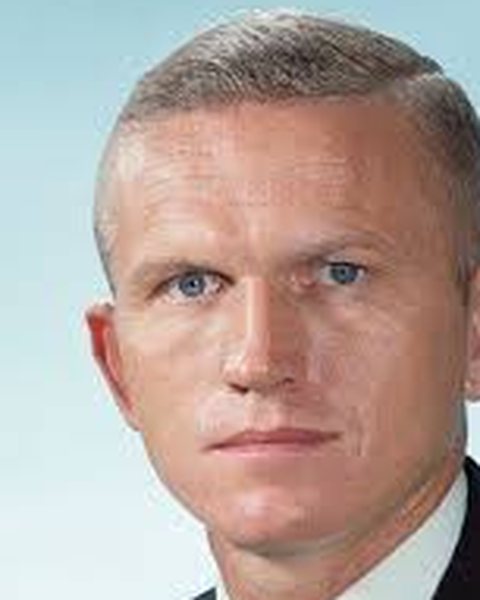
      Frank Borman in a suit beside an American flag

      Frank Borman1928–2023

      Born in Gary, Indiana. He graduated from West Point and earned a master's degree in aeronautical engineering at Caltech. He taught at West Point and flew as an Air Force test pilot. He commanded Gemini 7's 14 days in orbit and Apollo 8, the first flight to the Moon. Later he ran Eastern Air Lines.

      Map pin
      Germany
      Route in
      West Point → Caltech → test pilot
      Flights
      Gemini 7, Apollo 8
      GC

      Gene Cernan1934–2017

      Born in Chicago to a Slovak father and a Czech mother. He studied electrical engineering at Purdue on a navy scholarship and became a navy pilot. He flew Apollo 10 down to 15.6 km above the Moon. In 1972 he was the last man to walk on its surface.

      Map pin
      Czech / Slovak
      Route in
      Purdue → navy pilot → postgraduate school
      Flights
      Gemini 9A, Apollo 10, Apollo 17
      3went to Purdue
      3went to West Point
      2went to the Naval Academy
      11of 12 were military pilots when chosen. Armstrong had left the navy and was a civilian test pilot.