Philosophy · Time, distance and sacrifice · Five stars
Space travel at 99.5% the speed of light
You have a ship that flies at 99.5% of the speed of light. On board, time passes slowly. At home, it does not. Which stars can you visit, and who will be waiting when you come back?
Two clocks
When something moves very fast, time passes more slowly for it than for everything that stays still. This is called time dilation. At 99.5% of light speed, your ship clock runs about 10 times slower than the Earth clock. One year on board is 10.01 years at home.
The number 10.01 is called gamma (γ), the Lorentz factor. You find it from your speed:
So there are two ways to read "a 20-year trip". Twenty years on the ship clock carries you 199 light-years: further than every star in this lesson. Twenty years on the Earth clock only reaches the nearest stars.
All the times below assume the ship flies at full speed for the whole trip. A real ship would need time to accelerate at the start and decelerate at the end, which adds time to both clocks.
Mission console
Choose a speed and a time limit. The table shows how long each trip takes on each clock. A ✓ means the trip fits inside your limit.
| Destination | Distance (light-years) | One way Earth | One way ship | Round trip Earth | Round trip ship |
|---|
Times in years. Distances from the NASA Exoplanet Archive (Vega: about 25 light-years).
The destinations
Astronomers do not agree about every planet. Some are confirmed, some are only candidates, and some have been ruled out. This is how the evidence stands in 2026.
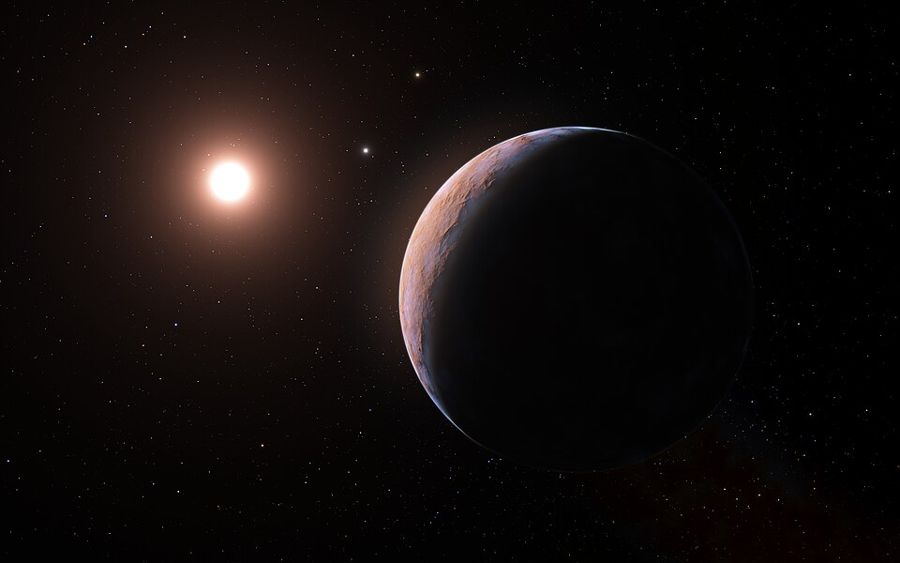
Proxima Centauri
Red dwarf · 4.24 light-years
- confirmedProxima b: a rocky planet in the habitable zone (found 2016).
- confirmedProxima d: a small planet close to the star (proposed 2022, confirmed 2025).
- candidateProxima c: proposed in 2020. A 2025 study with a new instrument could not confirm it.
Artist's impression of Proxima d · ESO/L. Calçada, CC BY 4.0
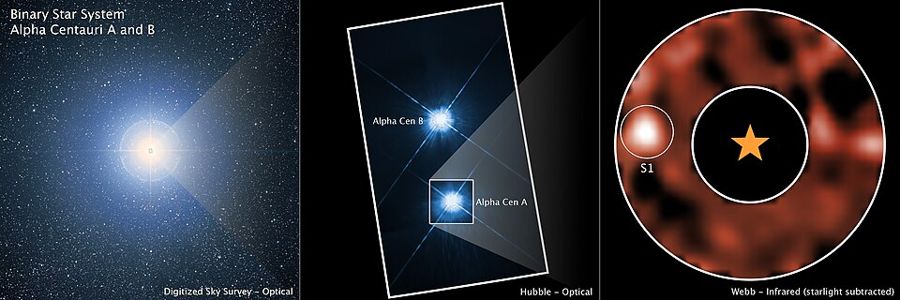
Alpha Centauri A
Sun-like star · 4.39 light-years
- candidateA gas giant, about the size of Saturn, in the habitable zone. The Webb telescope imaged a possible planet in 2025, but it has not been confirmed.
Alpha Centauri A and B: sky survey, Hubble and Webb (2025) · NASA, ESA, CSA, STScI, CC BY 4.0
Epsilon Eridani
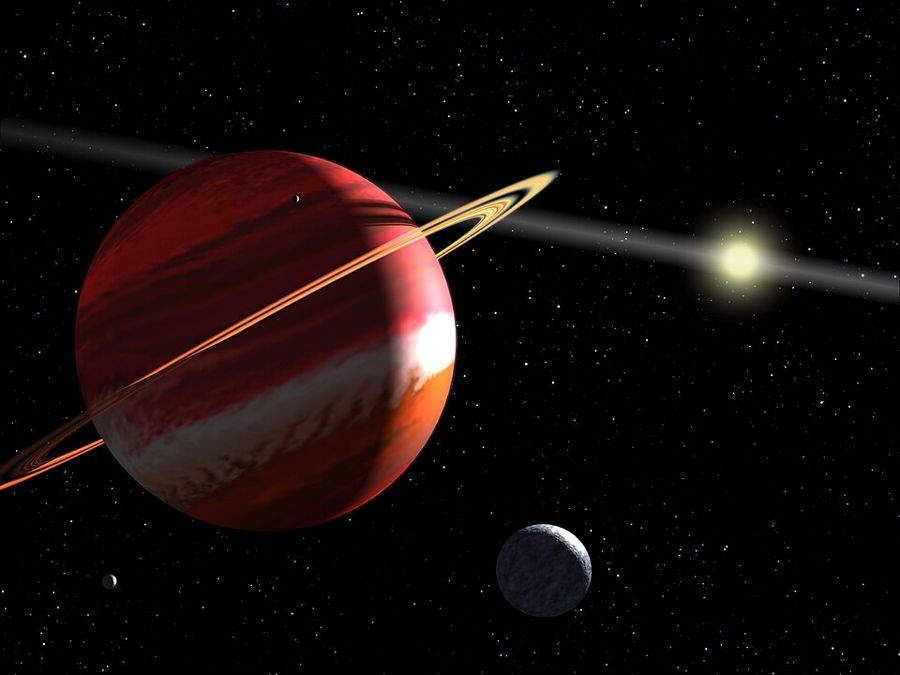
Young sun-like star · 10.45 light-years
- confirmedÆgir (Epsilon Eridani b): a gas giant.
- Two rings of rocky debris, where more planets may still be forming.
Artist's concept of Epsilon Eridani b · NASA, ESA, G. Bacon (STScI), public domain
Tau Ceti
Sun-like star · 11.75 light-years
- confirmedTau Ceti g, h, f: super-Earths found in 2017, but marked "controversial" by NASA in 2025.
- ruled outTau Ceti e: shown in 2025 to be a false signal, not a planet.

Vega
Hot, bright, young star · about 25 light-years
- candidateVega b: a possible "hot Neptune" very close to the star.
- Hubble and Webb (2024) found a very smooth, uniform dust disk. This rules out planets as large as Neptune or larger in wide orbits.
Vega's dust disk seen by Hubble (2024) · NASA, ESA, STScI, public domain
Word bank
These 24 words appear in this lesson, but you will meet them at work, in the news and in daily life. Every example is about life on Earth. The words you use in your answers below light up.
the place you are going to
Lisbon is a popular destination for students.
how long something lasts
The duration of the contract is two years.
measured by comparing with something else
Prices are low relative to last year.
a way of seeing a situation
From the manager's perspective, the delay was costly.
to go faster; to make something happen sooner
The company accelerated its hiring plan.
to slow down
Economic growth decelerated in the third quarter.
to calculate approximately; that calculation
The mechanic estimated the repair at $400.
close to, but not exactly
The meeting lasted approximately 45 minutes.
a small part of a whole
She paid a fraction of the original price.
possible and practical to do
Finishing by Friday is not feasible.
a person or thing being considered
There are three candidates for the job.
to show or say that something is true
Please confirm your booking by email.
facts that show something is true
The police found no evidence of a break-in.
to decide something is not possible
The doctor ruled out a broken bone.
good enough to live in
The old house is no longer habitable.
the same everywhere; not changing
The paint gives the wall a uniform colour.
broken pieces left after something is destroyed
Workers cleared the debris after the storm.
to circle around; a person's area of influence
He moved into the director's orbit after the promotion.
the path or direction something follows
Her career trajectory has been steadily upward.
the level at which something starts to happen
Income above this threshold is taxed at a higher rate.
giving up one thing to get another
Cheaper flights involve a trade-off in comfort.
to give up something valuable
He sacrificed weekends to finish his degree.
being alone or separated from others
Remote workers can suffer from isolation.
to go away and not take someone or something
She left her old life behind when she moved to Canada.
Your mission
Use: destination, duration, approximately
Use: trade-off, sacrifice, leave behind, isolation
Use: candidate, confirm, evidence, rule out, uniform
Use: feasible, perspective, relative