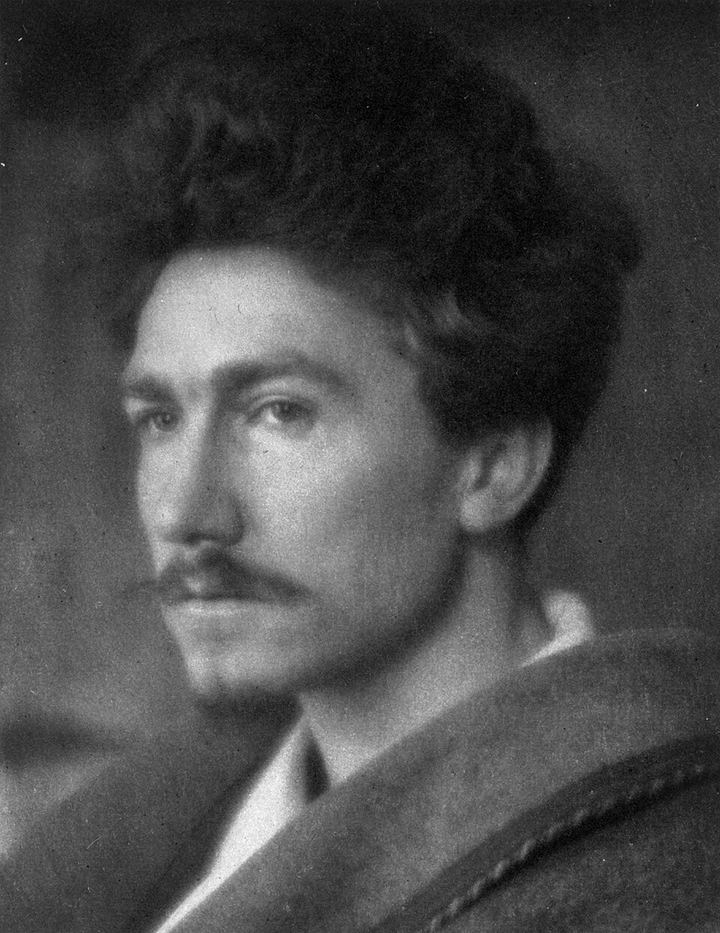
Ezra Pound: the man who knew everyone
In the 1910s and 1920s, one American poet sat in the middle of English literature. He edited Eliot, found publishers for Joyce, worked for Yeats and taught Hemingway to cut his sentences. Twenty years later he was in an American army cage in Italy, charged with treason.
This page is for reading. There are only two questions, one after each half. Read every text twice: once straight through, then again slowly, tapping the underlined words.
1. Who was Ezra Pound?
Ezra Pound was born in 1885 in Hailey, Idaho, and grew up near Philadelphia. In 1908 he sailed to Europe with very little money. He lived in London until 1920, in Paris from 1921 to 1924, and then in Rapallo, a small town on the coast of Italy.
He was a poet, but he was also an editor, a critic and a talent scout. His motto was “Make it new.” He believed the old, decorated poetry of the 1800s was dead. He wanted short, hard, exact words. He found young writers he believed in and pushed their work into print, often for no money.
The writers you are studying in this unit were his friends:
Open your copy of the poem. Above Part I, Eliot wrote: “For Ezra Pound, .”
Read Pound
A. The rules (1913)
In March 1913, Poetry magazine in Chicago printed two short pieces that started a movement called . The first lists three rules. The second is Pound’s advice to young poets, “A Few Don’ts by an Imagiste.”
The three rules
- Direct treatment of the “thing,” whether or .
- To use absolutely no word that does not contribute to the presentation.
- As regarding : to compose in the sequence of the musical phrase, not in sequence of a .
From “A Few Don’ts by an Imagiste”
An “Image” is that which presents an intellectual and emotional in an instant of time.
It is better to present one Image in a lifetime than to produce works.
Use no word, no adjective, which does not reveal something.
Don’t use such an expression as “dim lands of peace.” It dulls the image. It mixes an with the .
Go in fear of abstractions.
Don’t be descriptive; remember that the painter can describe a landscape much better than you can.
Ezra Pound and F. S. Flint, Poetry, March 1913.
B. In a Station of the Metro (1913)
Pound came out of a train at the in Paris in 1912 and saw a crowd of beautiful faces, one after another. His first poem about that moment was 30 lines long. He threw it away. Six months later he wrote one half as long, and threw that away too. A year later, this is what was left:
In a Station of the Metro
Ezra Pound. First printed in Poetry, April 1913.
Fourteen words and no verb. The poem does not say the faces are like petals. It puts one picture on top of the other and lets you feel the connection yourself. Pound called this “super-position.”
C. The River-Merchant’s Wife: a Letter (1915)
Pound read no Chinese. In 1913 the widow of the American scholar Ernest Fenollosa gave him her husband’s notebooks of Chinese poems, with word-by-word notes. From them Pound made a small book, Cathay (1915). This poem is his version of 《长干行》. If you know the Chinese poem, compare the two as you read.
The River-Merchant’s Wife: a Letter
By . Ezra Pound, Cathay, 1915.
Notice what the wife never says. She never writes “I miss you” or “I am lonely.” She shows you moss she cannot clear, butterflies in pairs, leaves falling too early. This is Pound’s rule at work: the thing itself carries the feeling.
D. Hugh Selwyn Mauberley, IV and V (1920)
Two years after the First World War, Pound said goodbye to London in a long poem called Hugh Selwyn Mauberley. These two short sections are about the men who fought. Read them next to Eliot’s dead crowd on London Bridge and Jake Barnes’s wound.
IV
V
Ezra Pound, Hugh Selwyn Mauberley, London: The Ovid Press, 1920.
E. What Hemingway said about Pound
In 1925, while he was writing The Sun Also Rises, Hemingway wrote a short piece for a Paris magazine, This Quarter, called “Homage to Ezra.” Here is part of it.
So then, so far, we have Pound the major poet devoting, say, one fifth of his time to poetry. With the rest of his time he tries to advance the fortunes, both material and artistic, of his friends. He defends them when they are attacked, he gets them into magazines and out of jail. He loans them money. He sells their pictures. He arranges concerts for them. He writes articles about them. He introduces them to wealthy women. He gets publishers to take their books. … And in the end a few of them refrain from him at the first opportunity.
Ernest Hemingway, “Homage to Ezra,” This Quarter, 1925.
Almost forty years later, in his book about Paris, Hemingway wrote that Pound taught him “to distrust adjectives as I would later learn to distrust certain people in certain situations.”
Ernest Hemingway, A Moveable Feast (written 1957–60, published 1964).
Question 1
Opposite sides
From Paris to the war
In Paris in the early 1920s, the people on this page drank in the same cafés, read each other’s drafts and lent each other money. By the late 1930s, Europe was splitting between fascism and its enemies, and the friends split with it. Pound and Hemingway ended up on opposite sides.
Ezra Pound
- 1924 Moves to Rapallo, Italy. Mussolini has ruled Italy since 1922.
- 1933 Meets in Rome on 30 January. Writes a book comparing him to Thomas Jefferson, Jefferson and/or Mussolini (1935).
- 1930s His poems and letters fill up with economics. He blames , and more and more he blames Jews. He supports Franco in the Spanish Civil War.
- 1941–43 Speaks on Rome Radio, paid by Mussolini’s government, hundreds of times. He attacks President Roosevelt, the war and the Jews, including after the United States enters the war in December 1941.
- 1943 On 26 July a court in Washington charges him with .
- 1945 Arrested in May. The U.S. Army holds him near Pisa, about three weeks in an open steel cage. There he writes The Pisan Cantos.
- 1945–58 Found mentally unfit to stand trial. Held for over twelve years in St Elizabeths, a hospital for the mentally ill in Washington.
- 1958 Released. When his ship reaches Italy, he gives the fascist salute to the cameras.
Ernest Hemingway
- 1926 The Sun Also Rises is published. In his 1925 letters Hemingway called Pound “Dear Duce,” as a joke: Il Duce, “the leader,” was Mussolini’s title.
- 1937–38 Goes to Spain four times as a war reporter. Supports the Spanish Republic against Franco and helps make the film The Spanish Earth.
- 1937 On 4 June, at Carnegie Hall in New York, gives one of his very few public speeches, against fascism.
- 1940 Publishes For Whom the Bell Tolls, a novel about an American fighting for the Republic in Spain.
- 1943 Reads copies of Pound’s broadcasts and writes to their friend Archibald MacLeish about them.
- 1944 War reporter in Europe. He watches the D-Day landings from a landing craft and enters Paris with its liberation in August.
- 1954 Wins the Nobel Prize in Literature.
- 1957 Signs a letter asking for Pound’s release and promises $1,500 to help him when he is free.
In their own words
Read the five short texts in order. Three are Hemingway; two are Pound.
There is only one form of government that cannot produce good writers, and that system is fascism. For fascism is a lie told by bullies. A writer who will not lie cannot live or work under fascism.
I think quite simply and definitely that American troops in North Africa, all of ’em ought to go back to America, if they can get there.
He is obviously crazy. … He deserves punishment and disgrace but what he really deserves most is . He should not be hanged and he should not be made a of.
This would be a good year to release poets.
The worst mistake I made was that stupid, of anti-Semitism.
Look back at Mauberley IV, written in 1919–20: “usury age-old and age-thick / and liars in public places.” The anger at money and liars is already there in the war poem. Twenty years later it had become hatred of a whole people, spoken on enemy radio during a war.