The two climbers
Warm-up: can you become someone by acting like them long enough? Think of one real example, from history, from the news, or from your own life, before you read on.
Paris in 1885
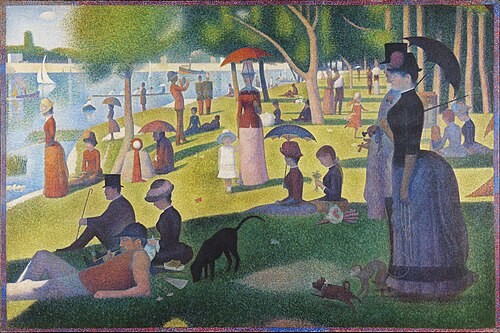
Seurat was painting this picture while Maupassant was writing Bel-Ami. He began it in 1884 and worked on it through 1885, the year the novel appeared; it was first shown in May 1886. The island of La Grande Jatte lies in the Seine just west of Paris. On Sundays, shop clerks, soldiers, nursemaids and fashionable couples walked there side by side, all in their best clothes.
Look at the figures. Each one stands alone, stiff and posed, dressed for the part. This is the Paris Duroy wants to conquer: a crowd of people performing respectability, where clothes may be the only proof of who you are.
Two men who invent themselves
Both heroes begin with nothing but a handsome face and an appetite. Both change their names. Both use other people, especially women, to rise. A French reader would call each of them a or an . The difference between them is what they want, and what they think of the people above them.
| Georges Duroy | Jay Gatsby | |
|---|---|---|
| Where he starts | Son of Norman peasants who keep a country inn at Canteleu; a former cavalry non-commissioned officer who served in Algeria | James Gatz, son of farmers in North Dakota; his father is Henry C. Gatz of Minnesota |
| His new name | Du Roy de Cantel: a noble-looking built from his home village’s name | Jay Gatsby |
| How he climbs | Journalism at the newspaper La Vie Française; affairs with married women; their money and their friends | The millionaire Dan Cody; with ; spectacular parties |
| What he wants | Money, rank, power. No single object: the next thing, always | Daisy, and through her a past he wants to repeat |
| What he thinks of the rich | Contempt mixed with hunger | Something close to worship |
| What the rich think of him | They use him, and he outplays them | Tom Buchanan calls him “Mr. Nobody from Nowhere” |
| How it ends | He marries Suzanne Walter at and looks across the river to parliament | He is shot in his pool; almost no one comes to the funeral |
| Who tells the story | A cold, ironic narrator outside the story | Nick Carraway, who half admires him |
Two kinds of resentment
Duroy resents people. Every humiliation, being poor, being laughed at, being patronized by his old friend Forestier, turns straight into a plan for revenge. He envies, then he takes. He seduces Forestier’s widow, then his employer’s wife, then his employer’s daughter. He is a , and the novel never proves him wrong.
Gatsby resents time. He does not hate old money; he wants to be let in. His enemy is the five years in which Daisy married someone else. When Nick tells him that you cannot repeat the past, Gatsby answers, “Why of course you can!” He is an , and the novel kills him for it.
Notice also who feels contempt for whom. In Bel-Ami the contempt comes from the climber. In Gatsby it comes from above: Tom’s sneer at the man from nowhere.
Study questions
Your answers save in this browser. After you write an answer, you can compare it with a sample answer.